Finding the Project Before the Funding
One of the biggest mistakes aspiring property developers make is thinking they need to secure funding before they find a development opportunity.
They assume the sequence should be:
Get the money → Find the project → Start developing
But that’s completely backwards.
The better approach is:
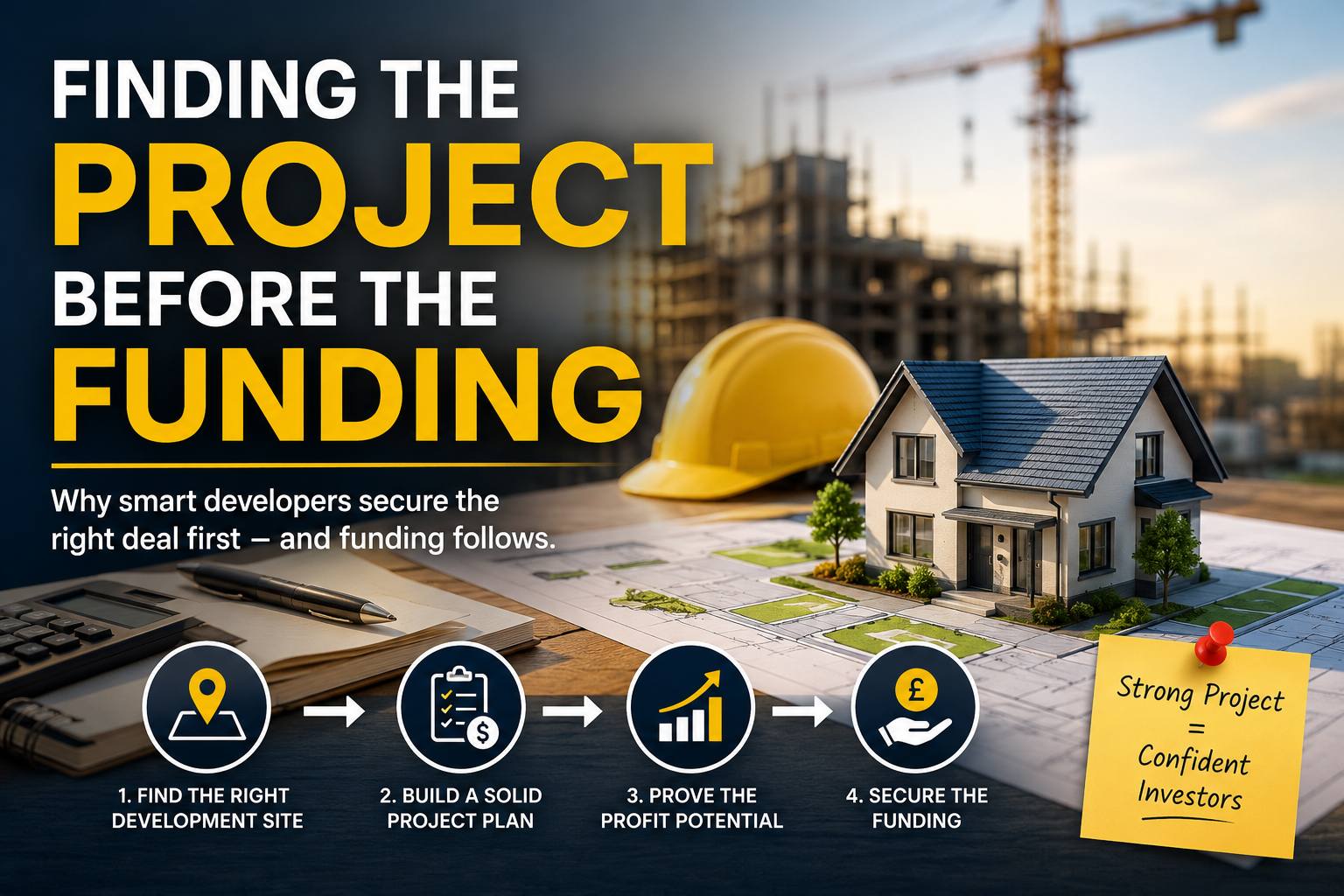
Find the project → Make sure the numbers work → Build the plan → Secure the funding
If you find the right project and can demonstrate that it is financially viable, raising the money becomes a much more realistic conversation.
Here’s why.
Why the Project Comes Before the Funding
Imagine approaching a commercial lender, private investor or development fund and saying:
"I'm looking for funding for a property development."
Their obvious next question is going to be:
What project?
Without an actual opportunity to assess, there is very little they can do.
A lender or investor needs to understand:
What you're planning to build
Where the development is located
What the land will cost
How much construction will cost
How long the project will take
What the completed development could be worth
What risks are involved
How and when their money will be repaid
Without a real project, none of those questions can be answered properly.
You're effectively asking someone to commit money to something that doesn't exist yet.
That's why your first priority shouldn't be chasing funding.
Your first priority should be finding and securing the right development opportunity.
Once you have something real to put in front of an investor, the conversation changes completely.
What Makes a Development Project Worth Backing?
Finding a site is only the beginning.
The next question is whether the project actually stacks up financially.
Not every potential development is worth pursuing, and experienced investors know that. They're interested in opportunities that offer sufficient profit relative to the risks involved.
As a rule of thumb, we target a minimum profit margin of around 25% of Gross Development Value (GDV).
Why?
Because property development rarely goes exactly according to plan.
You could encounter:
Higher-than-expected material costs
Labour cost increases
Construction delays
Planning complications
Supply chain problems
Unexpected professional fees
Additional site works
Changes in market conditions
Every unexpected cost eats into your profit.
If you've started with a very thin margin, it doesn't take much for a profitable development to become an unprofitable one.
A healthy margin gives the project room to absorb problems without destroying its viability.
Work Backwards From the End Value
When assessing a potential development opportunity, start with what the completed development could realistically be worth.
Then subtract your costs, including:
Land + Construction + Professional Fees + Finance + Contingency + Other Development Costs
What remains is your potential development profit.
If the numbers don't provide an adequate margin after realistic costs and contingencies, don't try to force the deal to work.
Sometimes the best development decision you can make is simply to walk away and find another site.
Ask yourself:
Does your current opportunity have enough margin to withstand something going wrong?
Where the Bigger Opportunity Can Be Found
There's another way developers can potentially increase the profitability of a project.
And this is where many people overlook a significant opportunity.
Instead of only searching for land that already has planning permission, look for opportunities where you can create additional value yourself.
This often means finding off-market land with development potential.
Many landowners have owned property for years without ever considering its development potential.
They may have inherited it.
They may have purchased it decades ago.
Or it could simply be surplus land they have never considered doing anything with.
Most importantly, they may not realise how much the value of that land could change if planning permission were obtained.
Creating Value Through Planning Permission
Land without planning permission has one value.
That same land with permission for a viable residential development can potentially have a very different value.
That increase is the land value uplift.
As a developer, you can create that uplift by identifying the opportunity, negotiating with the landowner and working through the planning process.
You're not simply buying something and hoping its value increases.
You're actively creating additional value.
That value may then be shared between you and the landowner depending on how the agreement is structured.
This can create an additional source of profit alongside the construction profit from the development itself.
For example, a project might target around 25% of GDV from the development, while the value created through planning could potentially increase the overall return further.
In the right circumstances, that could push the total profit towards 33% of GDV or more.
That's the difference between simply finding a development and creating a development opportunity.
So ask yourself:
Are you competing for obvious sites that already have planning permission, or are you looking for off-market opportunities where you can create value from the beginning?
Why a Strong Project Makes Funding Easier
Once you've identified a genuine development opportunity and established that the numbers work, your funding conversations become much more productive.
You're no longer approaching an investor with:
"I'd like to become a property developer. Will you fund me?"
Instead, you're saying:
"Here's the site. Here's what we're proposing to build. Here are the costs. Here's the expected value. Here's the profit. Here's the timeline. And here's how your investment will be repaid."
That's an entirely different conversation.
You're presenting an investment opportunity rather than an idea.
What Investors Want to See in Your Project Plan
Before approaching lenders or investors, you should have a detailed project plan.
It should clearly explain:
The development site
The proposed scheme
Planning status and strategy
Acquisition costs
Construction costs
Professional fees
Finance costs
Contingencies
Development timeline
Expected Gross Development Value
Expected profit
Exit strategy
Funding requirements
How the investor or lender will be repaid
A comprehensive project plan demonstrates that you've properly considered the opportunity.
It shows that you've identified potential risks and thought about how they can be managed.
Investors aren't being asked to take a blind leap of faith.
They can see the numbers.
They can understand the strategy.
And they can assess the risk for themselves.
That's what helps projects get funded.
So ask yourself:
If you were meeting an investor tomorrow, could you put a complete project plan in front of them?
If the answer is no, that's where your attention should be.
Don't Forget Your Build Route
There's another important part of the project that needs to be considered early:
How are you actually going to build it?
Your construction strategy shouldn't be something you start thinking about after you've already purchased the land.
Ideally, your build route should form part of your assessment from the beginning.
Depending on the development, your options could include:
A turnkey construction solution
A traditional main contractor
Managing elements of the construction yourself
Alternative construction or delivery methods
Each option comes with different costs, responsibilities, risks and timelines.
And those differences directly affect your development appraisal.
A project that initially appears to produce a strong margin can quickly become much less attractive if the construction strategy hasn't been properly costed.
That's why investors also want to understand how the development will actually be delivered.
A realistic construction strategy demonstrates that you've moved beyond simply identifying a site.
You've thought about execution.
And execution is ultimately what turns the spreadsheet into a completed development.
What Should You Do Next?
If you're currently trying to get into property development, stop making funding your first priority.
Instead, start with the opportunity.
Your next steps should be:
Identify one potential off-market development site.
Investigate its planning potential.
Work out what you could realistically build.
Estimate the completed development value.
Calculate the land, construction, professional and finance costs.
Build in realistic contingency.
Calculate the potential profit margin.
Decide how the project could be built.
Create a clear project plan.
Then start approaching potential funding partners.
You don't need ten potential sites.
Start with one credible opportunity and investigate it properly.
The Money Follows the Project
The fundamental principle is simple:
Don't find the money and then look for somewhere to put it.
Find the right project and then find the right money for that project.
A strong development opportunity gives lenders and investors something tangible to assess.
It demonstrates what you're building, how much it will cost, where the profit comes from and how their capital will be returned.
And if you can identify off-market land where planning permission has the potential to create additional value, you may be able to improve the economics of the project even further.
So stop asking:
"Where can I find the funding?"
Start asking:
"Where can I find the right project?"
Find the site.
Understand the numbers.
Build the plan.
Then go and find the funding.