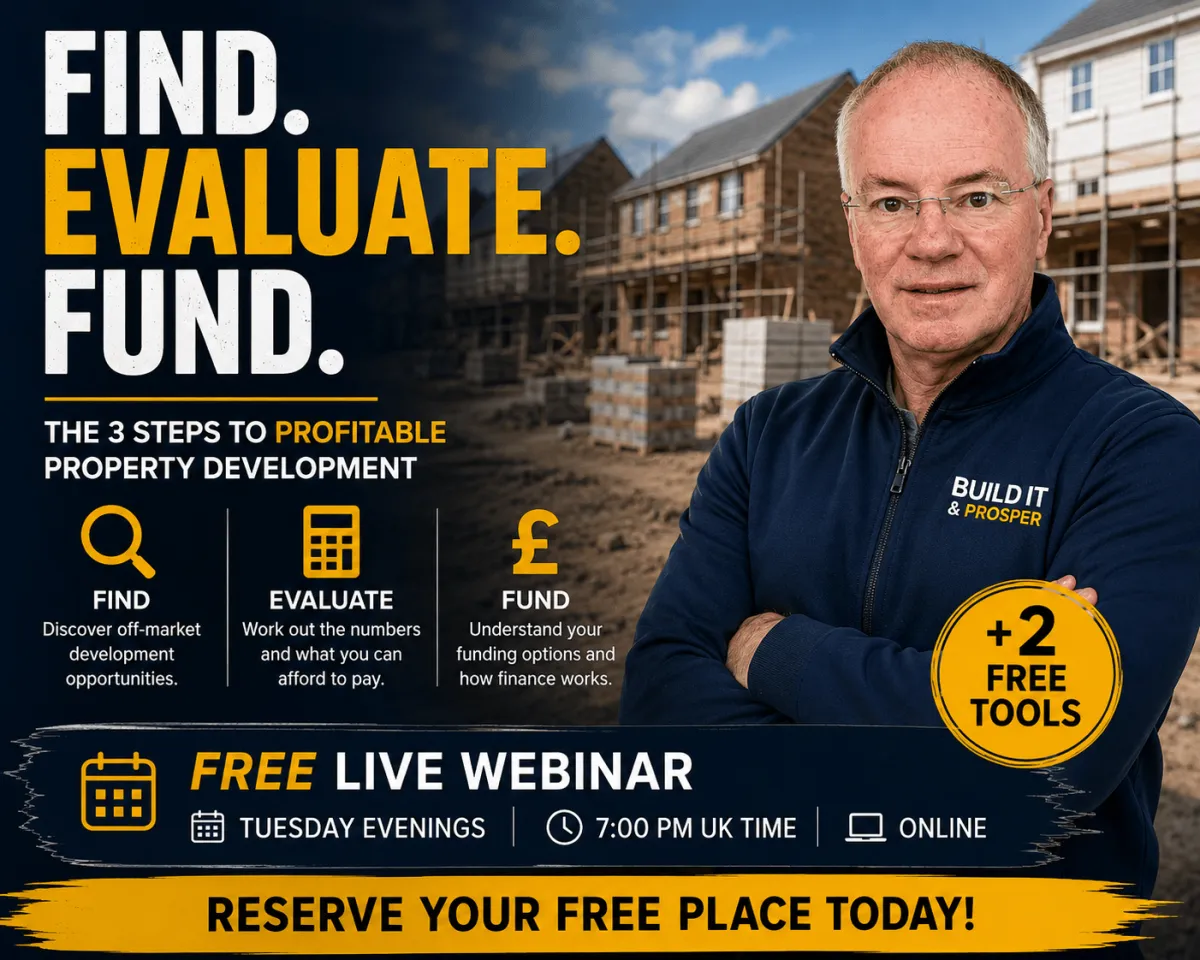
How to Find Land for Property Development in the UK
Finding land at the right price is one of the biggest challenges facing aspiring property developers in the UK. But what if you could find development opportunities before they even reach the open market?
If you've spent hours searching Rightmove, Zoopla or PrimeLocation, you'll know how frustrating the process can be.
You finally find a promising plot, only to discover that several other developers are interested, the asking price is too high, or somebody has already secured it.
The problem isn't necessarily that suitable land doesn't exist. It's that you're competing with everyone else for the same advertised opportunities.
I'm Jim J Davidson, and through my experience in property development, I've developed a structured approach to finding, assessing and securing development land.
It's the process we teach in our Find It Property Development Course, and it consists of three essential stages:
DETECT → DETAIL → DEAL
In this guide, I'll explain how these stages work and how you can use them to identify potentially profitable development opportunities.
Why Is Finding Development Land in the UK So Difficult?
One of the biggest obstacles facing new property developers is competition.
When a development site appears on a major property website, you're unlikely to be the only person interested.
Other developers may already be investigating its potential, calculating costs and preparing offers.
If it's a particularly attractive opportunity, it could be secured before you've had enough time to complete your assessment.
There's also another problem.
Just because land is advertised for sale doesn't mean it's financially viable for development.
The asking price might be too high once you consider construction costs, infrastructure, planning expenses, professional fees and your required profit.
That's why I encourage developers to explore off-market land.
Rather than competing for sites that are already advertised, you can identify potential development opportunities and approach landowners directly.
This can give you more time to investigate the site and negotiate an agreement that works for both parties.
Stage 1: DETECT – How to Find Off-Market Development Land
The first stage of our land-finding process is called Detect.
It focuses on three activities: understanding planning requirements, identifying potential development sites and contacting landowners.
Understand Local Planning Requirements
Before searching for land, you need to understand what planning authorities are likely to consider acceptable.
Most off-market sites won't already have planning permission.
This means you need a working knowledge of the planning considerations that could affect a development.
For example:
How many houses could potentially fit on the site?
Is there sufficient space between buildings?
How could the development affect neighbouring properties?
Are there daylight or privacy considerations?
Does the site appear suitable for residential development?
You don't need to become a planning expert overnight.
However, understanding the basic requirements will help you recognise promising opportunities and eliminate unsuitable sites early.
The aim is to spend your time investigating land with genuine development potential.
Look Beyond Traditional Property Websites
One of the advantages of finding off-market land is that you may face less competition.
Imagine identifying a plot that isn't advertised for sale.
You can investigate its potential, assess whether the numbers work and approach the owner without the immediate pressure of competing buyers.
In some cases, the owner might not even have considered selling.
This is where identifying opportunities before they reach the market can become particularly valuable.
Find and Contact the Landowner
Once you've identified a potential site, the next challenge is establishing who owns it.
Unlike a house, an empty piece of land doesn't necessarily have an obvious address or someone you can contact directly.
HM Land Registry can be a useful starting point, although not every piece of land has a registered title.
Some older landholdings may require further investigation.
Once you've established ownership, you can approach the landowner and explore whether they're interested in discussing a potential development arrangement.
The Find It course covers different approaches to identifying land and contacting owners.
Stage 2: DETAIL – How to Assess Development Land Viability
Finding a plot is only the beginning.
The next question is much more important:
Can you develop it profitably?
This is where our second stage, Detail, becomes essential.
Before negotiating with the landowner, you need to establish the financial viability of the proposed development.
I recommend working backwards from the estimated selling value of the completed properties.
Step 1: Calculate Gross Development Value (GDV)
Gross Development Value, or GDV, is the estimated total selling value of a completed development.
Let's consider an example.
Imagine you've found a site that could accommodate ten houses.
Each house is expected to sell for £200,000.
Development details | Value |
|---|---|
Number of houses | 10 |
Selling price per house | £200,000 |
Gross Development Value | £2,000,000 |
Your estimated GDV is £2 million.
This becomes the starting point for calculating how much you can afford to pay for the land.
Step 2: Deduct Your Target Development Profit
When assessing development opportunities, I use a target profit of 25% of Gross Development Value.
Using our example:
£2,000,000 × 25% = £500,000
That gives us a target development profit of £500,000.
After deducting this amount from GDV, we have £1.5 million remaining to cover development costs and the land purchase.
This is a target used in our appraisal method, not a guaranteed profit.
Step 3: Calculate Construction and Development Costs
Next, you need to calculate the costs associated with the proposed development.
These can include:
Planning applications and professional fees.
Architectural drawings and consultants.
Site infrastructure and utilities.
Construction materials and labour.
Development finance and associated costs.
Infrastructure costs are particularly important.
For example, electricity, water and gas connections might appear to be nearby, but that doesn't necessarily mean the existing services have sufficient capacity for your development.
Construction costs also vary according to the design and specification of the houses.
A slate roof may cost considerably more than a concrete tiled roof, while dormer windows can have different cost implications from rooflights.
That's why it's important to calculate build costs for the particular project rather than relying on a generic figure.
Step 4: Calculate the Residual Land Value
Once you've estimated the GDV, required profit and development costs, you can calculate the residual land value.
Residual Land Value = GDV − Target Profit − Development Costs
Let's compare two examples.
Viable development | Unviable development | |
|---|---|---|
GDV | £400,000 | £400,000 |
Target profit (25%) | £100,000 | £100,000 |
Development costs | £250,000 | £310,000 |
Residual land value | £50,000 | −£10,000 |
In the first example, £50,000 remains available for the land.
In the second example, the residual land value is negative £10,000.
That means the project wouldn't meet our financial requirements, even if the land were available for nothing.
This is precisely why development appraisals are so important.
A site that looks attractive isn't necessarily a profitable development opportunity.
The Three Types of Development Site Appraisal
We use three levels of appraisal to assess development opportunities.
Each stage provides more detail and helps determine whether the site deserves further investigation.
1. Desktop Appraisal
The desktop appraisal is your initial assessment.
You don't need to visit the site.
Instead, you estimate its potential development value, construction costs, required profit and residual land value.
This allows you to identify opportunities that appear financially viable.
If the numbers don't work, you can move on without spending significant time or money.
2. Initial Appraisal
If the desktop appraisal looks promising, the next stage involves visiting the site.
Here, you examine physical characteristics that could affect development costs.
For example, you might investigate roof designs, construction specifications and other site-related considerations.
The aim is to improve the accuracy of your initial calculations.
3. Full Appraisal
The full appraisal involves a more detailed investigation of the proposed development.
By this stage, you should have a clearer understanding of the site's potential, expected costs and financial viability.
This information becomes particularly valuable when you begin negotiating with the landowner.
Rather than making an arbitrary offer, you can explain how you've calculated the land's value.
Stage 3: DEAL – Negotiating and Securing Development Land
Once you've identified a suitable site and established that the numbers work, it's time to negotiate.
This is the third stage of our process: Deal.
A detailed appraisal gives you a stronger foundation for negotiations because you can explain the financial reasoning behind your offer.
But there's another important consideration.
Understanding Planning Gain and Land Value Uplift
Land without residential planning permission can be worth considerably less than land with permission to build houses.
If you successfully obtain planning permission, you may increase the value of the land before construction begins.
This potential increase is commonly referred to as planning gain or land value uplift.
It can create an additional profit opportunity beyond the development profit from constructing and selling the completed properties.
However, obtaining planning permission involves costs and uncertainty.
That's why any negotiation should recognise both the risks you're taking and the potential increase in land value.
How Option Agreements Can Protect Your Interests
One approach to securing development land is through an option agreement.
Instead of purchasing the land immediately, an appropriately structured agreement can give you the right to purchase it under agreed conditions.
This may allow you to investigate planning opportunities without committing the full purchase price at the outset.
Land promotion agreements are another possible approach.
The important point is to protect your interests legally before spending significant money pursuing planning permission.
Otherwise, you could spend money improving the development potential of land that you don't control.
Appropriate legal advice is essential when structuring these agreements.
Can You Start Property Development with Limited Capital?
One question I regularly hear is:
"Can I get involved in property development if I don't have much money?"
The answer depends on the project and how you structure the opportunity.
You don't necessarily need to purchase every potential development site outright before investigating its planning potential.
By negotiating suitable agreements, you may be able to secure an interest in land while limiting your initial financial commitment.
There will still be costs, including legal fees, planning applications, consultants and architectural drawings.
You'll also need to consider how the eventual development will be funded.
Possible funding sources include private investors and bank finance.
These financing costs should be included in your development appraisal from the beginning.
Why Successful Developers Build a Pipeline of Sites
Property development shouldn't depend entirely on finding one perfect opportunity.
You want to develop a repeatable process for identifying and progressing suitable sites.
Think of it as a conveyor belt.
You might be identifying new plots, assessing others, negotiating agreements and progressing suitable opportunities through planning.
Over time, this approach can help you create a pipeline of potential developments.
Finding your first site may take considerable effort, but having a structured process makes it easier to work consistently.
The key is to keep identifying and evaluating opportunities rather than relying on occasional searches.
Introducing the Find It Property Development Course
I created the Find It Property Development Course to help aspiring developers overcome one of the biggest obstacles in property development: finding viable land.
The course follows our Detect, Detail and Deal roadmap.
It includes:
11 training modules covering the land-finding process.
50 different methods of finding potential development land.
Practical workbooks and appraisal systems.
Templates used in our land-finding process.
Sample agreements, including an option agreement.
Access to the Find It community.
Lifetime access to the core course training.
The course presentation also explains the optional group coaching programme, where participants can ask questions, discuss potential deals and learn from others.
The aim is to provide a structured process that you can apply throughout your property development journey.
Do You Need Previous Experience to Find Development Land?
You don't necessarily need previous construction or property development experience to start learning how to find land.
People enter property development from many different backgrounds.
Some are accountants, solicitors and other professionals. Others work in construction or completely unrelated industries.
What's important is your willingness to learn and apply the process.
However, I wouldn't suggest that finding development land is easy.
Suitable sites can be difficult to identify, planning requirements can be complicated and negotiations don't always lead to successful agreements.
Consistency, research and careful financial assessment are essential.
Final Thoughts: How to Find Profitable Development Land in the UK
Finding development land involves much more than browsing property websites.
You need to understand planning requirements, identify potential sites, assess financial viability, negotiate with landowners and protect your interests.
That's why I recommend following our three-stage process:
DETECT: Identify off-market opportunities and establish land ownership.
DETAIL: Assess development potential, calculate costs and determine whether the numbers work.
DEAL: Negotiate suitable terms and secure your interests before progressing the project.
By following a structured process, you can approach land finding with greater confidence and make more informed decisions.
Remember, the goal isn't simply to find land.
The goal is to find land that can support a viable and profitable property development project.