
A Quick Way to Value Land — A Huge Time Saver for Property Developers
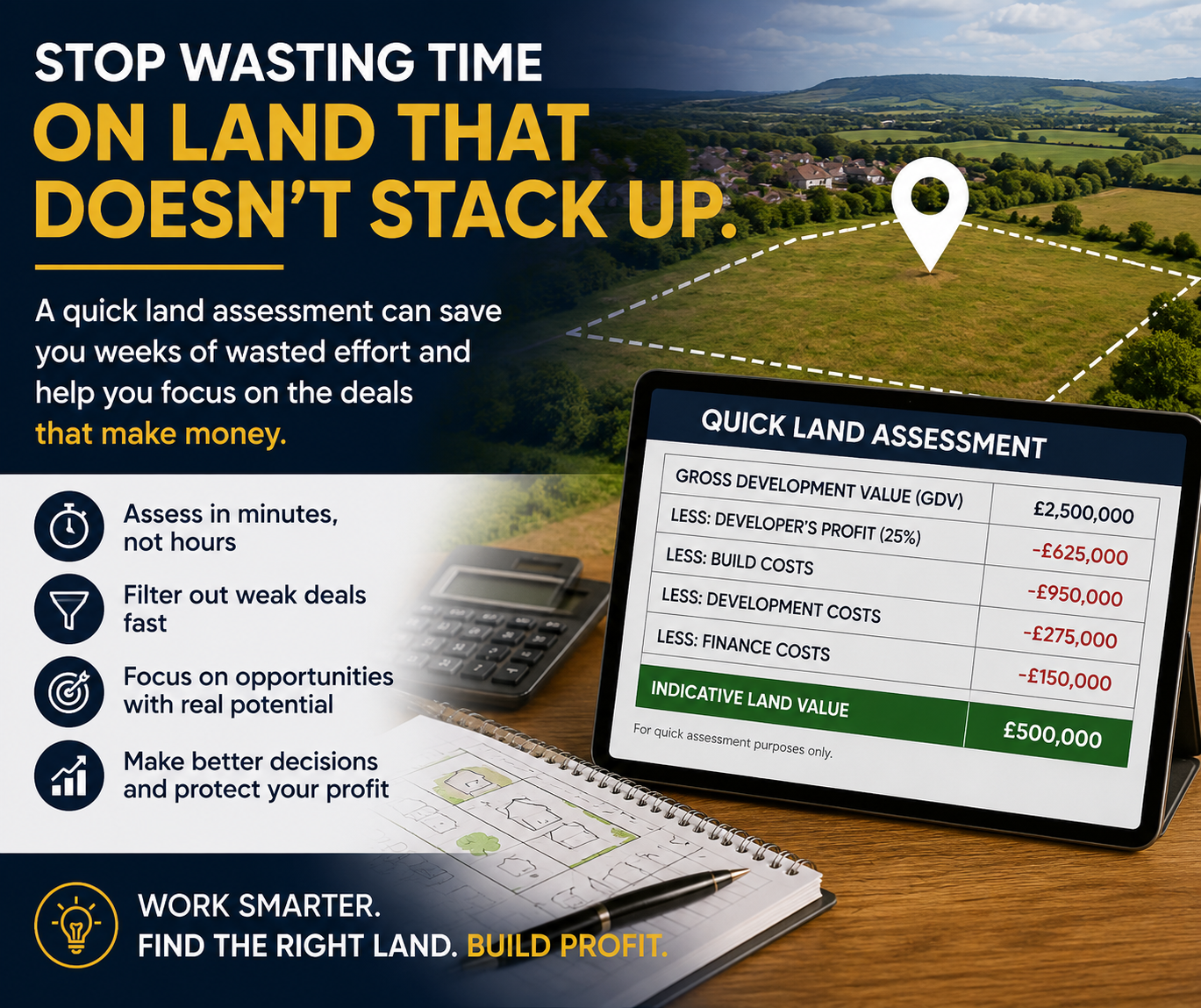
If you're looking for development land, one of the biggest mistakes you can make is spending hours analysing sites that were never viable in the first place.
The reality is that most potential development sites don't stack up financially. Successful property developers don't make money by analysing every opportunity in depth—they make money by quickly filtering out poor opportunities and focusing their time on the sites that have real potential.
That's exactly why I developed a Quick Land Assessment Tool.
It isn't designed to replace a full development appraisal. Instead, it gives you a fast indication of whether a site deserves further investigation or whether it's time to move on to the next opportunity.
Why Speed Matters
Finding profitable development land is largely a numbers game.
You'll probably look at dozens—or even hundreds—of sites before finding one that makes financial sense.
If you're spending several hours analysing every piece of land you come across, you'll waste an enormous amount of time.
A quick screening process allows you to eliminate poor opportunities in minutes, leaving you free to concentrate on the sites that have genuine development potential.
The Principle Behind Land Valuation
At its simplest, land value is calculated by working backwards.
You start with the Gross Development Value (GDV)—the estimated value of the completed development once all the properties have been sold.
From that figure you deduct:
Developer's profit
Construction costs
Development costs
Finance costs
Whatever remains is effectively the maximum amount you should be paying for the land.
Why Developer Profit Comes First
One of the most common mistakes new developers make is forgetting that profit is a cost.
If a site already has planning permission and is ready to build, a developer should typically expect around a 25% profit on Gross Development Value.
Without allowing for this margin, you could easily overpay for the land and leave yourself with little—or no—profit at the end of the project.
Off-Market Land Creates Additional Value
Many of the best opportunities aren't already sitting on the market with planning permission.
Instead, developers identify land with potential and secure planning themselves.
By taking on the planning risk, investing time, expertise and money, they create additional value in the land.
That uplift in value shouldn't simply be handed back to the landowner—it forms part of the developer's reward for taking the risk.
The Four Main Costs Every Developer Must Consider
The quick assessment tool takes into account four major areas:
1. Build Costs
These are the physical costs of constructing the buildings.
Using an accurate cost per square metre provides a solid starting point for estimating the construction budget.
2. Development Costs
These include everything outside the physical build itself, such as:
Planning costs
Legal fees
Site preparation
Welfare facilities
Health and safety
Infrastructure
These are often overlooked by inexperienced developers but can have a significant impact on profitability.
3. Finance Costs
Development finance is very different from a residential mortgage.
Commercial lending typically includes:
Arrangement fees
Interest
Exit fees
Other finance charges
These all need to be included when assessing a site's viability.
4. Land Value
Once all of the above costs have been deducted from the Gross Development Value, you're left with the amount available to pay for the land.
If the figure is too low—or even negative—you know immediately that the project isn't worth pursuing.
A Small Change Can Make a Huge Difference
One of the most interesting things about development appraisals is how sensitive they are.
For example:
A slight reduction in selling prices can wipe out all the profit.
Losing just a few units from the scheme can turn a profitable project into a loss.
A modest increase in costs can make the land virtually worthless.
This is exactly why a quick assessment tool is so valuable—it highlights warning signs before you've invested hours into researching a site.
Remember—This Isn't a Full Appraisal
The Quick Land Assessment Tool is designed as an initial filter.
Once a site passes this first stage, it should then go through a much more detailed appraisal that considers:
Full development costs
Detailed finance modelling
Risk assessment
Site constraints
Deal analysis
Offer strategy
That's where a comprehensive appraisal system becomes essential.
Get the Free Assessment Tool
To help property developers assess opportunities more efficiently, I'm making the Quick Land Assessment Tool available as part of a free trial of the Hidden Land Accelerator Programme.
You'll also receive:
The Quick Land Assessment Tool
A comprehensive Build Cost Model
Additional training resources to help you source and evaluate development opportunities
Even if you decide not to continue after the trial, you get to keep the Quick Assessment Tool and the Build Cost Model.
Final Thoughts
Successful property development isn't about analysing every opportunity—it’s about identifying the right opportunities as quickly as possible.
The faster you can eliminate unsuitable sites, the more time you'll have to focus on deals that can genuinely make you money.
A simple screening tool won't replace a full appraisal, but it can save countless hours and dramatically improve the efficiency of your land sourcing process.
If you're serious about finding profitable development opportunities, having a quick way to value land could become one of the most valuable tools in your property development toolkit.