Raising Finance for Property Development

Most people think raising finance for a property development deal is incredibly difficult.
They spend months chasing investors, building investor lists, writing business plans, preparing pitch decks and dealing with rejection after rejection.
But there’s something important they’re missing:
Investors don’t want to fund your idea. They want to fund a real deal.
Once you understand that difference, the whole conversation around raising finance changes.
The Mistake Most Aspiring Property Developers Make
One of the biggest mistakes I see is people trying to find finance before they have found a deal.
They build an investor list. They prepare presentations. They write business plans. Then they approach investors and try to convince them to believe in what they’re going to do.
The problem is that an investor needs something concrete to evaluate.
They’re not primarily funding your confidence, your vision or your enthusiasm.
They’re looking at a specific property development opportunity with real numbers attached to it.
Think about it from the investor’s perspective.
If you approach them without a deal, you’re essentially asking them to believe in you and what you might be able to achieve.
But when you approach them with a genuine opportunity, the conversation becomes very different.
Now they can look at:
The land
The purchase price
The planning potential
The development costs
The expected sales values
The projected profit
The numbers either work or they don’t.
That gives the investor something tangible to assess.
Find the Deal Before You Find the Finance
Before spending your time building investor lists and creating elaborate pitch decks, ask yourself a simple question:
If an investor asked me right now to show them the exact land I want to develop, what it costs, what I can build and what profit it could generate, could I do it?
If the answer is no, that’s the gap you need to close first.
You need to find the deal before you find the finance.
What Are Property Investors Actually Looking For?
Investors already have something you need: money.
What many of them need are suitable opportunities in which to deploy that money.
They’re not simply looking for more people with ideas. They’re looking for opportunities where the numbers make financial sense.
That means the deal itself becomes your most important asset.
Your background, experience and network can all play an important part in an investor’s decision. But without a viable opportunity, there is very little for them to assess.
Before approaching an investor, you should therefore understand:
Where is the land?
Know the exact location and what makes the site potentially suitable for development.
What is the purchase price?
Understand what the landowner wants and, more importantly, what the land is actually worth to you as a developer.
What are the development costs?
You need a realistic understanding of what it will cost to complete the development.
What is the planning potential?
Know what could realistically be built on the site, subject to the appropriate planning process.
What is the projected profit?
Your appraisal should clearly demonstrate whether there is sufficient margin in the project.
If you can’t confidently explain these numbers, you’re probably not ready to start raising finance.
A Real Example: Why the Numbers Matter
Let me give you an example from our community.
Someone identified a plot of land where the landowner believed the site was worth somewhere between £250,000 and £300,000.
Instead of simply accepting that valuation, they carried out a proper financial appraisal.
They looked at comparable sales, assessed the market, considered the planning potential and calculated what the land was realistically worth as a development opportunity.
Their appraisal suggested a figure closer to £90,000.
They eventually negotiated the land down to approximately £100,000.
That is the kind of opportunity that can create a much more compelling conversation with potential investors.
It isn’t simply about delivering a confident pitch.
It’s about presenting a deal where the numbers have been properly researched and appraised.
The Three-Step Process
The sequence matters.
Instead of looking for finance first, approach property development in this order:
Step 1: Find the Land
Start by identifying potential land opportunities.
One approach is to look for off-market land — sites that haven't necessarily been openly marketed for development.
These could include plots where a landowner hasn’t considered selling, overlooked pieces of land or properties with development potential that hasn’t yet been recognised.
Finding opportunities before they reach a competitive open market can sometimes give you more scope to negotiate and structure a deal.
Step 2: Appraise the Opportunity
Once you have identified a potential site, carry out a proper financial appraisal.
You need to understand:
The realistic land value
Acquisition costs
Planning potential
Construction costs
Professional fees and other development costs
Expected sales values
Finance costs
Contingencies
Projected profit
Don't guess.
Your assumptions need to be realistic and supported wherever possible.
When you understand the numbers, you’re no longer approaching an investor with an abstract idea.
You can say:
Here’s the land. Here’s what it costs. Here’s what we believe can be built. Here’s what the development could sell for. And here’s what the financial appraisal currently shows.
That creates a much more substantive conversation.
Step 3: Approach Investors
Once you have found and properly appraised an opportunity, you can start discussing finance.
Instead of saying:
"I want to become a property developer. Would you invest in me?"
You’re able to present a specific opportunity and explain the assumptions behind it.
The investor can then conduct their own assessment, challenge your assumptions and decide whether the opportunity meets their requirements.
Why Buying the Land at the Right Price Matters
One of the most important stages of any development is the land acquisition.
Pay too much for the site and you can put the profitability of the entire project under pressure before construction has even started.
That’s why understanding the residual value of the land and negotiating appropriately is so important.
You cannot rely on making up for an expensive land purchase later by simply building more cheaply or hoping property prices increase.
Your appraisal needs to work using realistic assumptions from the beginning.
A Real Deal Changes the Finance Conversation
Imagine how different it feels approaching an investor when you already have a genuine opportunity in front of you.
You’re not simply asking for money.
You’re presenting a potential investment opportunity.
You have identified the land, researched the planning position, estimated the development costs and worked through the potential returns.
That doesn't guarantee that an investor will fund the project — investors will have their own criteria, due diligence requirements and risk appetite.
But it gives them something meaningful to evaluate.
And that is the key difference.
Build a Pipeline, Not Just One Deal
Finding one development opportunity is a great start.
But if you want to build a sustainable property development business, you need to develop the ability to find opportunities consistently.
That means creating a repeatable process for:
Finding land → assessing opportunities → negotiating → appraising → securing finance → developing
Once you understand this process, property development becomes less about waiting for the perfect opportunity and more about consistently identifying and assessing potential sites.
Learn to Find and Appraise Deals Properly
Knowing the sequence is one thing.
Executing it correctly is another.
You need to know how to spot opportunities that others overlook and, just as importantly, how to determine whether those opportunities actually make financial sense.
That starts with learning how to identify potential off-market land opportunities in your area.
Then you need to develop the skills to appraise those opportunities properly so that, when you do approach potential investors or lenders, you can present clear and well-researched numbers.
A structured sourcing system combined with disciplined financial appraisal can make the process much more repeatable.
Ready to Find Your First Property Development Deal?
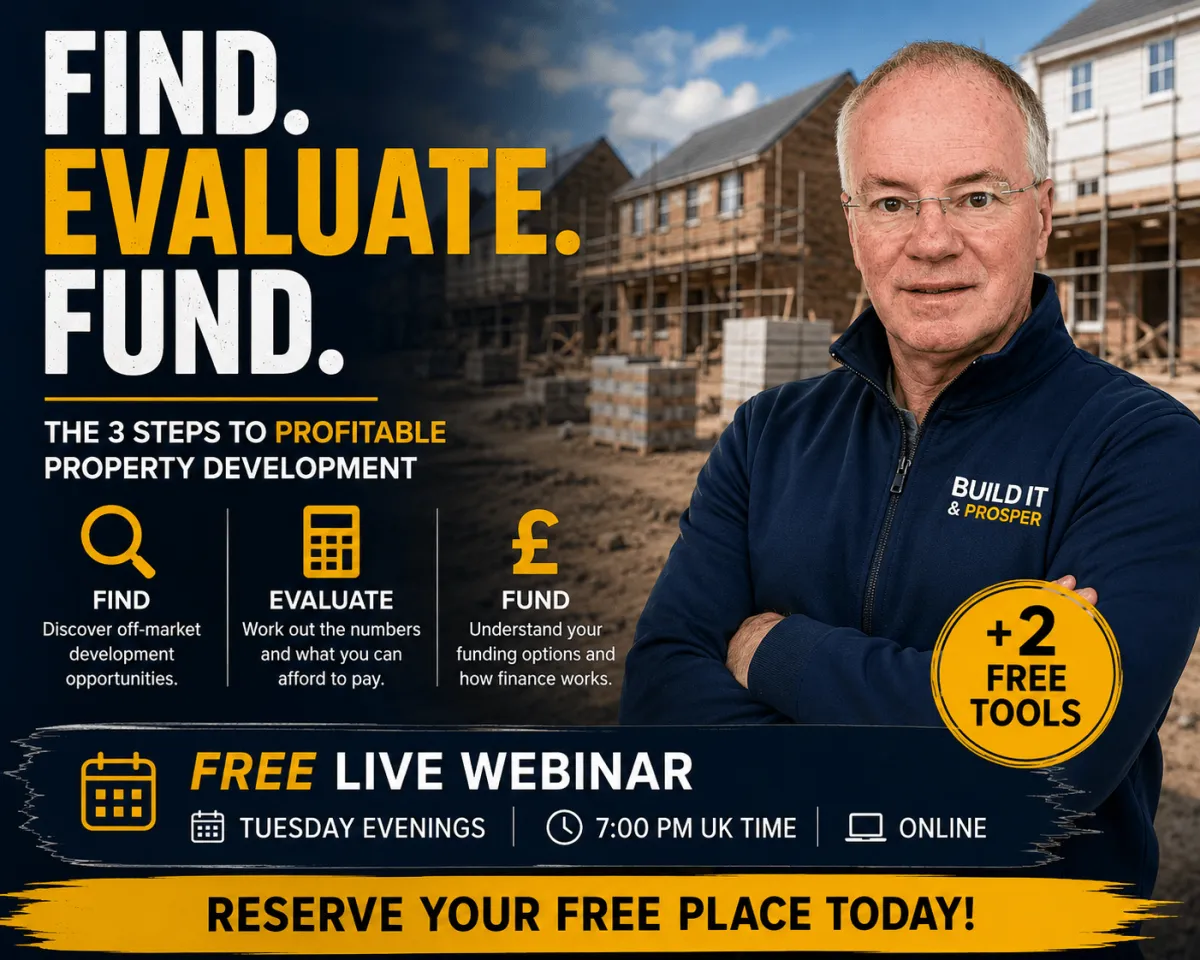
If you want to learn how to identify off-market opportunities and properly appraise potential development sites, join us for our live Tuesday evening webinar.
We’ll walk you through the process of spotting potential opportunities in your area, assessing the numbers and understanding what you need before approaching potential sources of finance.
You’ll also have the opportunity to ask questions and learn more about the structured process we use when assessing property development opportunities.
Join us on Tuesday and start working towards your next property development deal.