
Ransom Strips: The Legal Trap That Can Destroy a Property Deal
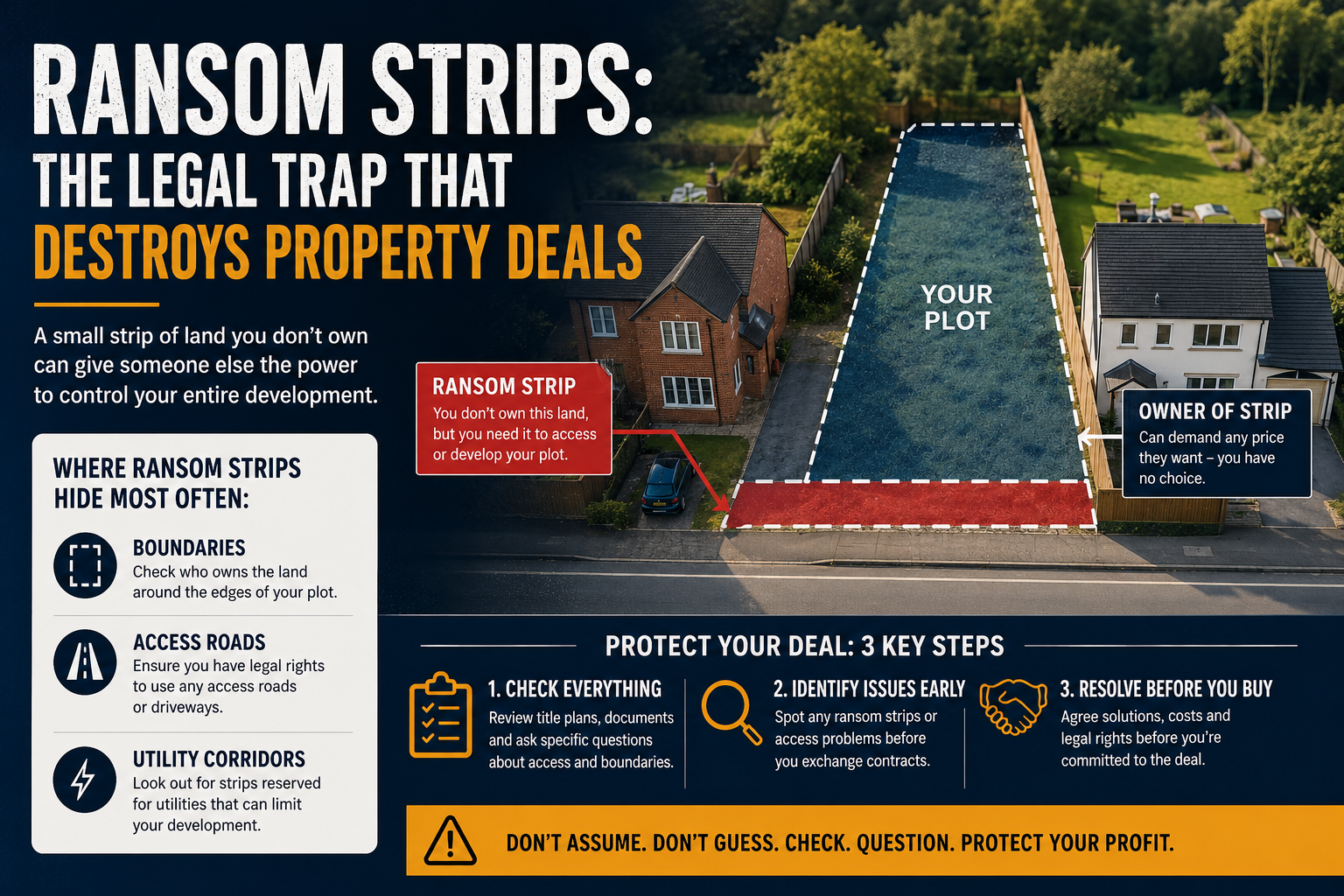
You’ve found a promising development site. The numbers work, the location looks right, and the potential profit makes sense.
Then you discover that a tiny piece of land you don’t own stands between your development and the access it needs.
Suddenly, that small strip of land could put the entire deal at risk.
Welcome to the world of ransom strips.
For new property developers in particular, ransom strips can be easy to overlook during the excitement of assessing a potential site. Yet an access or boundary problem discovered too late can dramatically change the economics of a development.
The good news is that these problems can often be identified during due diligence—provided you know what to look for.
Here’s how ransom strips work, where they commonly appear, and the checks you should make before committing to a property deal.
What Is a Ransom Strip?
A ransom strip is a small piece of land owned by somebody else that you need to cross, access or otherwise use in order to develop your property.
Imagine you've found a plot on the edge of a village.
It appears to have road frontage, but when you examine the title plan carefully, you discover a narrow two-metre strip between your site and the road.
That strip belongs to the neighbouring landowner.
If you don't already have the necessary legal right to cross it, your development could suddenly depend on securing an agreement with that owner.
And they know you need them.
That gives the owner considerable negotiating leverage.
Ransom strips can arise because of the way land was historically divided. A landowner might have sold part of a larger parcel decades ago while retaining a narrow strip or access route. Years later, when the land behind it becomes valuable for development, ownership of that small strip can become extremely important.
Why Ransom Strips Matter to Property Developers
The problem isn't necessarily the physical size of the strip.
It's what that strip controls.
You might own an otherwise excellent development site, but if you can't legally access it, connect infrastructure as required or use the full development area, your plans could be severely restricted.
That can affect:
The number of units you can build
The usable development area
Site access
Infrastructure and utilities
Development costs
Negotiating leverage
Overall profitability
This is why checking the title, boundaries and access arrangements needs to be part of your due diligence—not something you leave until after you've committed to the purchase.
The Three Places Ransom Strips Can Hide
Ransom strips and related access problems tend to appear in several predictable areas.
Knowing where to look makes them easier to identify.
1. Around the Boundaries of the Site
Start by looking carefully at every boundary.
Does the land you're considering actually connect directly to the public road?
Are there any gaps between the development site and adjoining land?
Who owns those areas?
Don't simply rely on the written description of the property. Examine the title plan and understand where the legal boundaries actually sit.
Whenever possible, compare the plans with what you can physically see on the site.
2. Access Roads and Driveways
This is particularly important.
If your development is accessed using a road or driveway you don't own, establish what legal rights exist to use it.
You may own the development land itself, but that doesn't automatically mean you have every right required to access it across somebody else's property.
Check whether the appropriate rights of way are registered and make sure your professional advisers understand your proposed development use.
3. Utility Corridors
Don't forget about utilities.
Land may be affected by rights or restrictions associated with:
Water
Electricity
Drainage
Sewers
Other infrastructure
These can potentially affect where you can build and how much of the site is genuinely developable.
A relatively narrow corridor may appear insignificant on a plan but could become much more important once you start designing the development.
These three areas—boundaries, access routes and utility corridors—are specifically highlighted as places developers should investigate when assessing a site.
The Real Cost of Discovering a Problem Too Late
Consider a hypothetical development site with planning permission for eight houses.
You calculate:
Land cost + construction costs + professional fees + finance + contingency + sales costs = a profitable development.
Everything looks good.
Then you discover that access to part of the site is affected by land controlled by somebody else.
Without resolving the issue, perhaps the scheme needs to be redesigned or fewer houses can be built.
Now your original appraisal is meaningless.
Worse still, if you've already committed to purchasing the property, your negotiating position may be considerably weaker.
The owner of the relevant land knows you need an agreement.
That's why the most important principle is simple:
Discover access and boundary problems before you commit—not afterwards.
How to Protect Yourself: A Three-Step Process
Due diligence doesn't guarantee that every property deal will work.
What it can do is help you understand the risks before you've put yourself in a vulnerable position.
Here are three important steps from the development process.
Step 1: Get the Right Survey
Don't think only about valuation.
Make sure the appropriate survey work considers the site's boundaries and access arrangements.
Be explicit about what you want investigated.
Ask your surveyor to identify potential boundary discrepancies, access concerns or other issues that could affect development.
Never assume something will automatically be checked simply because it's important to you.
Ask the question directly.
Step 2: Examine the Title Information
Review the relevant Land Registry title information and plans as part of your due diligence.
Among other things, you'll want to understand:
The property's legal boundaries
Registered rights of way
Easements
Restrictions
Relevant adjoining ownership
Anything potentially affecting access
The important point isn't simply obtaining the documents.
It's understanding what they mean for your proposed development.
Your solicitor or conveyancer should advise you on the legal implications.
Step 3: Resolve Problems Before Exchange
If due diligence identifies a potential ransom strip or access issue, investigate it before exchanging contracts.
Where another owner's agreement may be required, establish whether the necessary rights can be secured and on what terms.
The original source emphasises doing this before exchange so that you still have the ability to reconsider the deal if the issue can't be resolved satisfactorily.
Finding a Ransom Strip Doesn't Automatically Kill the Deal
Discovering an issue during due diligence isn't necessarily bad news.
Finding it after you've committed is the dangerous part.
If you identify a ransom strip or significant access issue early enough, you can evaluate your options.
Depending on the circumstances and professional advice, those options might include:
Renegotiating the purchase price.
If resolving the problem creates an additional development cost, that may need to be reflected in what you're willing to pay for the land.
Asking the seller to resolve the issue.
You may decide that obtaining the necessary rights should be dealt with before you complete the purchase.
Walking away.
Sometimes the numbers simply don't work once the problem is understood.
Walking away from a bad deal isn't failure.
It's successful due diligence.
The important distinction is that you're making the decision with information rather than discovering the problem when your options are limited.
Run the Numbers Twice
Here's another useful habit.
When you're evaluating a site where access could potentially become an issue, consider more than one financial scenario.
Scenario A: Clear Access
Run your appraisal assuming the required access rights are already secure and no additional expenditure is necessary.
Scenario B: Additional Access Costs
Then test what happens if you have to spend additional money resolving access or related legal issues.
Ask yourself:
Would I still want this development if resolving the problem cost another £10,000?
What about £15,000?
£25,000?
If a relatively modest additional cost destroys your entire profit margin, you need to know that before you commit.
A deal that only works when everything goes perfectly may not provide enough margin for risk.
Your Ransom Strip Due Diligence Checklist
Before committing to your next development site, work through these five questions.
1. Does the Property Have Clear Access?
Does the site connect directly to the road?
If access crosses somebody else's land, what legal rights exist?
Get the answer documented.
2. Have You Checked the Title Plan?
Look for gaps, unusual boundary lines, restrictions and anything else that doesn't immediately make sense.
Ask questions until you understand what you're looking at.
3. Have You Asked About Rights and Restrictions?
Ask your legal adviser to investigate relevant rights of way, easements, access restrictions and potential ransom-strip issues.
Don't rely solely on verbal assurances.
4. Has Your Surveyor Specifically Checked Access and Boundaries?
Make this part of the brief.
Tell your surveyor that you want potential access and boundary problems identified because you're evaluating the property for development.
5. Have You Stress-Tested the Deal?
Run the development appraisal assuming everything is straightforward.
Then run it again assuming you have additional costs associated with securing access.
Does the deal still work?
If not, you may need to renegotiate, restructure the opportunity or walk away.
These checks form the repeatable due-diligence approach outlined in the source material.
Don't Let Assumptions Cost You Money
One of the biggest dangers in property development is assuming somebody else has checked something.
You assume the seller would have mentioned an access problem.
You assume the solicitor will spot everything automatically.
You assume the survey will cover exactly what you're worried about.
You assume the boundary shown on the marketing plan is the legal boundary.
Successful due diligence means replacing assumptions with questions.
Who owns this land?
How do I legally access it?
What rights come with the title?
Are there restrictions affecting development?
Does somebody else control something my development depends upon?
And perhaps most importantly:
Do I have the answers before I'm financially committed?
The Bottom Line
A tiny strip of land can have an enormous impact on a development.
That's why ransom strips shouldn't be treated as an obscure legal technicality. For developers, they're part of understanding whether you genuinely control the land and access required to deliver your proposed scheme.
So before committing to your next site:
Check the boundaries.
Check the access.
Check the title.
Ask the right questions.
Stress-test the numbers.
And where anything is unclear, get appropriate professional advice before proceeding.
Because the best time to discover a problem isn't after you've bought the site.
It's while you still have the power to do something about it.
Want a Repeatable Due Diligence Process?
Download our Property Development Checklist for the key questions to ask when evaluating a site, including ransom strips, access, title checks and the information to discuss with your professional team.
Use it on every potential deal so that checking the details becomes part of your process—not an afterthought.