
Roof Costs in Property Development: What Developers Need to Know
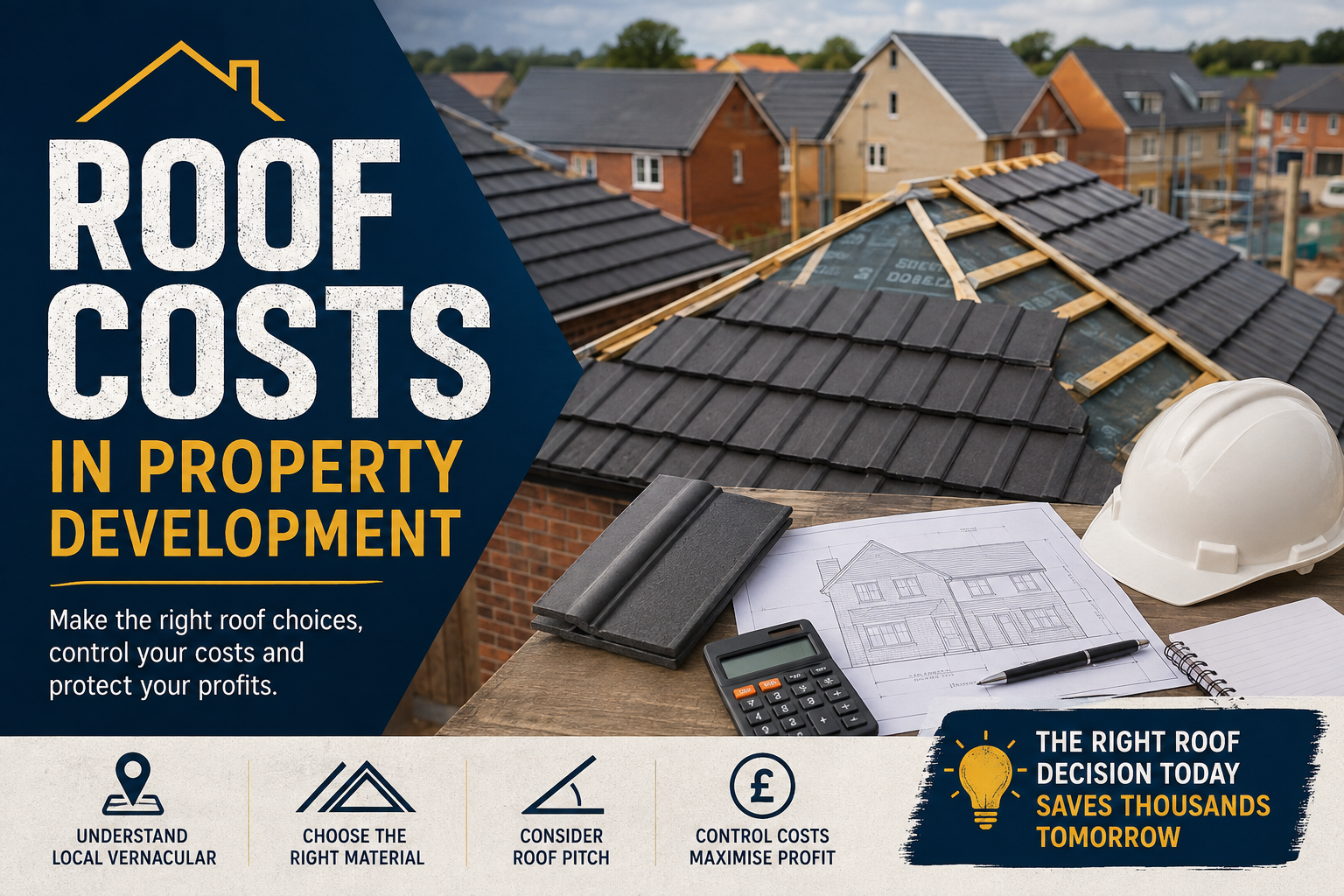
Most property developers miss one of the biggest cost traps hiding right above their heads: the roof.
Your choice of roof can add thousands of pounds to your build costs. Get it wrong, and you could face higher material costs, increased labour charges and even planning complications.
The good news is that roof costs can be controlled when you understand what drives them.
In this guide, we'll look at how local vernacular, roofing materials, roof pitch and specialist requirements affect your development budget—and how to make decisions that protect your profit margin.
Your Roof Choice Starts With the Local Area
The first thing to understand is that your roof choice isn't always really a choice.
In many cases, it's heavily influenced by the area you're developing in.
This comes down to local vernacular—the architectural style and materials commonly found in a particular location.
Walk down a typical UK residential street and look at the surrounding properties. If almost every house has a concrete tile roof, that's an important signal. If you're developing a new property there, planning officers may expect the design to complement the existing character of the neighbourhood.
Matching the local vernacular isn't simply about aesthetics. It can affect both:
Planning approval
Development costs
Trying to introduce an unnecessarily expensive or dramatically different roofing system could increase your costs while creating additional planning challenges.
Research the Area Before Buying Land
Before you even think about buying a site, spend some time studying your target development area.
Walk around and look at existing properties.
Ask yourself:
Are most roofs concrete tile?
Is natural slate common?
What roof pitches are typical?
Are there specialist or premium roofing materials?
Are neighbouring properties relatively uniform in appearance?
Take photographs of the roofs and make notes about the materials being used.
A couple of hours of research can give you valuable information that helps shape your design, specification and development budget.
Ideally, photograph 10 to 15 comparable properties so you have a good understanding of what's typical for the area.
Concrete Tiles: The Most Cost-Effective Option
Where the local vernacular allows them, concrete tiles are generally one of the most cost-effective roofing options for UK property development.
There are two main reasons.
First, the material itself is typically cheaper than alternatives such as natural slate.
Second, installation is generally faster and doesn't require the same level of specialist skill associated with some premium roofing materials.
If concrete tiles are standard in your target area, there's often little reason to unnecessarily upgrade the roof specification.
Remember:
Expensive materials don't automatically create a premium development.
Your specification should reflect the expectations of your target market and the surrounding area.
For example, imagine you're developing in a suburban neighbourhood where almost every property has concrete roof tiles.
If you suddenly decide to use natural slate without a clear planning, design or commercial reason, you could increase your material and labour costs without adding proportional value to the finished property.
You may even create additional planning complications.
That's a poor trade-off.
Roof Pitch Can Have a Major Impact on Labour Costs
Roofing material is only part of the equation.
One of the most overlooked factors in property development budgeting is roof pitch.
Roof pitch refers to the angle or steepness of the roof.
Generally, the steeper the roof, the more difficult and time-consuming it becomes to work on.
From a roofer's perspective, a gentler pitch can make it easier to move around safely and lay materials efficiently.
A steep roof can require:
Additional safety measures
More experienced labour
Slower installation
Increased time on site
And increased time usually means increased labour costs.
When reviewing your development plans, pay close attention to the specified roof pitch.
You may not always have complete control over it because the design could be influenced by planning requirements, building standards and neighbouring properties.
However, understanding the cost implications allows you to budget more accurately from the beginning.
If you're calculating development costs without considering roof pitch, you could be underestimating the true cost of construction.
Slate Roofs: Understand the Additional Cost
If you're developing in an area where slate roofs are part of the local character, you'll need to account for a significantly different cost structure.
Slate can be considerably more expensive than concrete tiles because you're dealing with both higher material costs and more specialist labour.
Slate installation can involve greater material coverage because of the required overlaps, while the installation itself requires specialist knowledge and experience.
You can't necessarily take a roofer experienced with standard concrete tiles and expect the same speed or results with natural slate.
A traditional 1½-storey property with a slate roof, for example, may require specialist roofers familiar with appropriate slate installation techniques.
Depending on the design, material and complexity of the roof, the difference compared with concrete tiles can be substantial.
That's why you shouldn't simply take a concrete tile estimate and assume a slate roof will cost roughly the same.
Get Slate Quotes Early
If slate is common in your target development area, obtain specialist quotes early in the feasibility process.
Your costs can be affected by three major factors:
Higher material costs
Greater specialist skill requirements
Longer installation times
Combined, these can have a major impact on your overall development budget.
Understanding those costs before committing to a site can prevent an unpleasant surprise once construction begins.
What About Specialist Roofs?
Beyond concrete tiles and slate, there are numerous specialist roofing options available.
These could include:
Standing seam metal roofs
Premium composite systems
Bespoke architectural roofing
Other specialist or contemporary materials
These systems can look impressive, but they can also be significantly more expensive.
Unless you're developing an upmarket property where a specialist roof is appropriate for the local architecture and target buyer, think carefully before adding one to your specification.
Ask yourself:
Is this a standard-market development or a premium development?
If you're building standard family homes in a suburban neighbourhood, an expensive specialist roofing system may add cost without generating enough additional value.
If you're developing a high-value luxury property in an area where premium materials are expected, the calculation may be completely different.
Your specification needs to match your market position.
How Much Does a Roof Cost Per Square Metre?
It's tempting to search for a simple roof cost per square metre and plug that number into your development appraisal.
The problem is that roofing costs can vary significantly.
Factors include:
Roofing material
Roof pitch
Roof shape and complexity
Material quality
Labour availability
Specialist installation requirements
Scaffolding and access
Location
Architectural details
Because of these variables, general industry figures should only ever be treated as an early guide.
For a serious development appraisal, you need project-specific quotes from local roofing contractors.
A roofer who understands your area, specification and project will give you far more useful information than a generic national average.
Don't Guess—Get Actual Roofing Quotes
Once you've established what's appropriate for the area, speak to local roofing specialists.
Don't simply estimate.
Don't guess.
And don't assume the roof will somehow fit within your general construction allowance.
Get actual quotes.
You need to understand whether the roof you're planning could represent a relatively modest cost or become a major line item in your development budget before you commit significant capital to the project.
Early quotes also give you an opportunity to compare specifications and identify potential savings while you're still able to change the design.
Your Roof Is a Cost-Control Decision
The critical point is simple:
Your roof isn't just a design decision. It's a cost-control decision.
The right roof specification needs to balance:
Local architectural character
Planning expectations
Construction costs
Labour requirements
Target market expectations
End value
Get these factors right early and you give yourself a much better chance of protecting your development margin.
Get them wrong and you could spend the rest of the project trying to recover from a budget overrun that could have been identified during feasibility.
Your Next Steps
Before progressing with your next development:
Visit your target area. Look at comparable properties and identify the dominant roofing materials and styles.
Photograph 10–15 properties. Create a simple record of roof materials, designs and approximate pitches.
Review your proposed roof pitch. Understand whether the design could increase labour and installation costs.
Identify specialist requirements. If slate or another specialist material is required, factor that into your feasibility calculations immediately.
Get local roofing quotes. Use real contractor pricing rather than relying solely on generic cost-per-square-metre estimates.
Update your development appraisal. Make sure the true roofing cost is reflected before committing to the project.
Final Thoughts
Successful property development isn't only about finding a good site or achieving a strong selling price. It's about understanding the individual decisions that can gradually eat into your profit margin.
The roof is one of those decisions.
Understand the local vernacular. Choose materials appropriate for the market. Account for roof pitch and specialist labour. Get real quotes early.
Do that work upfront, and you'll have a far clearer picture of your actual construction costs—and a much stronger foundation for developing profitably.