
Why SearchLand Alone Won’t Make You a Successful Property Developer
Why SearchLand Alone Won’t Make You a Successful Property Developer
Last week, I had a conversation with someone who had just invested in SearchLand.
Now, SearchLand is a platform we absolutely support, and we offer access to it for our mentorship students. It can be a very useful tool for identifying potential development opportunities.
But this person had made one critical assumption:
They thought that once they had SearchLand, they had effectively solved the property development puzzle.
And that’s simply not how property development works.
You can have the best land-finding tool in the world, but if you don’t know what to do once you’ve found a potential site, you’re still going to struggle to turn that opportunity into a profitable development.
So, let’s look at why SearchLand alone isn’t enough — and what you actually need to become a successful property developer.
SearchLand Is a Tool — Not a Complete Solution
SearchLand is useful.
But it’s still a tool.
And tools don’t build deals. People build deals.
The person I spoke to had invested in SearchLand expecting it to be their ticket into property development. They believed they had finally found the missing piece.
When I explained everything that comes after finding a site, you could almost see the light bulb switch on.
Because here’s something many aspiring developers don’t initially realise:
Finding land is perhaps 10% of the challenge.
The other 90% is knowing what to do once you’ve found it.
Think about it.
If finding land was all you needed to become a successful property developer, wouldn’t everyone with access to a land-finding platform already be completing profitable developments?
They’re not.
And that tells you something important.
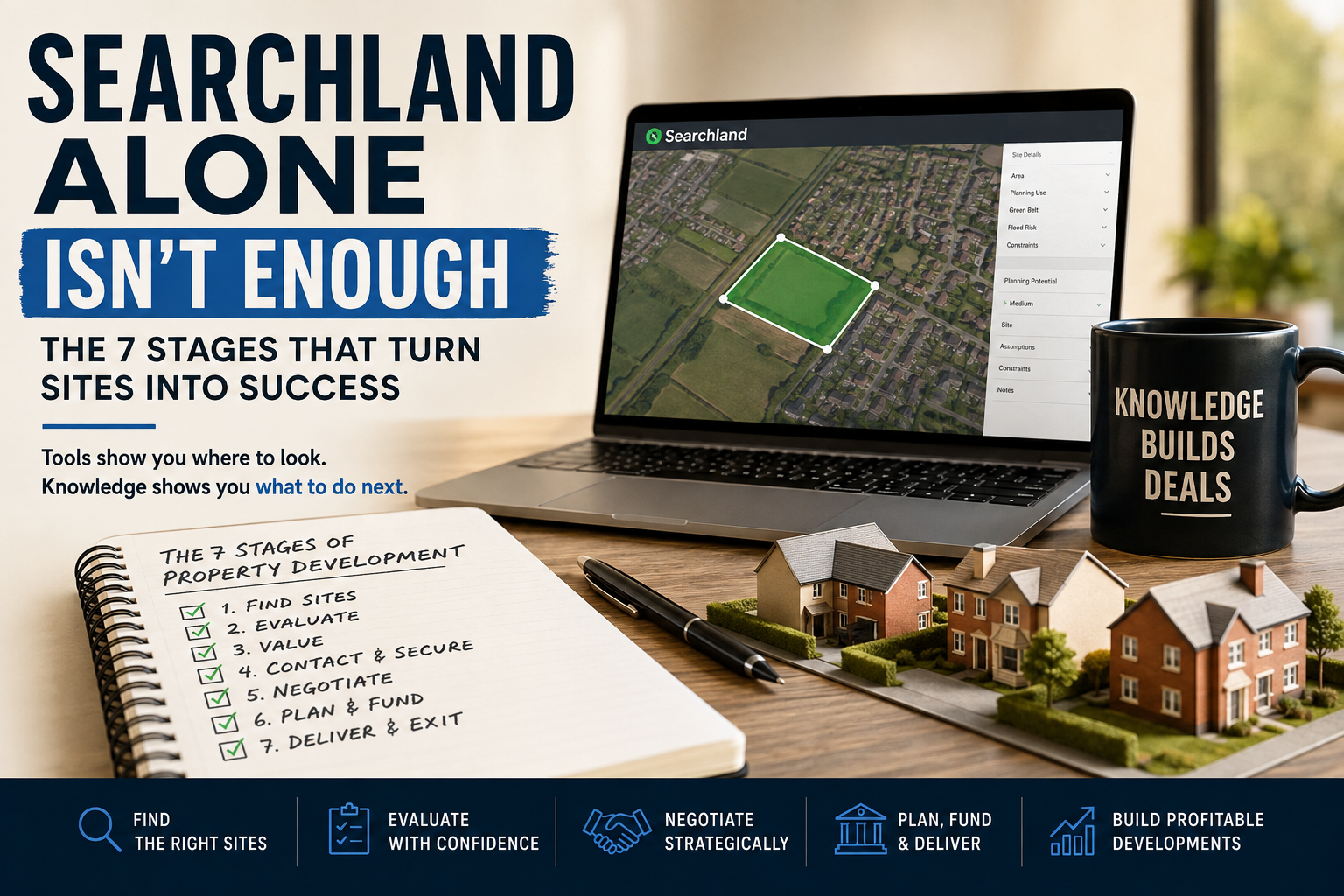
The 7 Stages of Property Development Success
There are seven core stages you need to understand if you want to succeed in property development.
SearchLand can help you with Stage 1.
But you still need to master the other six.
Stage 1: Find Potential Development Sites
This is where SearchLand can be extremely useful.
It can help you identify potential sites and uncover opportunities that you may otherwise have missed.
But it’s important to remember that there are many ways to find development land.
You can use:
Mapping and land-finding software
Direct-to-landowner approaches
Networking and professional relationships
Local knowledge
Estate agents and other property professionals
Off-market opportunities
In fact, some of the best development opportunities may never appear on the open market.
Finding a site is important.
But it’s only the beginning.
Stage 2: Evaluate the Site Properly
This is where many aspiring developers start to struggle.
Finding a piece of land doesn’t automatically mean you’ve found a viable development opportunity.
You need to understand:
Local planning policies
Site constraints
Local market conditions
Access and infrastructure
Development potential
Whether the numbers are realistically going to work
Too many aspiring developers get excited because they’ve found what looks like a great site.
Then they spend days or weeks investigating it, only to discover that it was never realistically developable in the first place.
Proper site evaluation allows you to identify those problems much earlier.
Stage 3: Work Out the Valuation Correctly
Valuation is another area where mistakes can quickly become expensive.
Surveyor valuations can vary significantly depending on the purpose and context of the valuation.
For example:
Are you valuing the property for sale purposes or lending purposes?
That distinction matters.
You need to understand which valuation applies to your situation and how it affects the overall viability of your deal.
Get the valuation wrong and your projected profit can disappear very quickly.
Stage 4: Contact the Landowner and Secure the Site
Once you’ve identified a promising opportunity, you need to find and approach the landowner.
But this isn’t simply about cold calling as many people as possible or sending generic letters.
It’s about strategic outreach.
You need to understand:
Who you’re approaching
How to approach them
What might motivate them
How to start the conversation
How to build trust
And if the landowner is interested, you then need to know how to secure control of the site legally.
Ideally, you want to structure the opportunity in a way that protects your position without unnecessarily tying up large amounts of your own capital.
Stage 5: Negotiate the Deal
Making contact is only the beginning.
Next comes negotiation.
You need to understand what the landowner wants, what you need from the deal and how to create a structure that works for both parties.
Good negotiation isn’t simply about trying to force the lowest possible purchase price.
It’s about understanding motivations and finding a solution that allows the deal to move forward.
Negotiation is a skill — and it’s a skill that can be learned.
Stage 6: Take It Through Planning and Fund the Project
Now the development itself begins to take shape.
You need to understand how to navigate the planning process, work with the appropriate professionals and secure the funding required to deliver the project.
Depending on the complexity of the development, this stage can take months — sometimes even years.
You may need to deal with:
Planning consultants
Architects
Surveyors
Engineers
Local authorities
Lenders and investors
Contractors and other professionals
A mistake at this stage can derail an otherwise excellent opportunity.
Stage 7: Complete the Development and Exit Successfully
Finally, you need to deliver the project and execute your exit strategy.
That could mean selling the completed development, refinancing it or following another strategy depending on your original plan.
You need to understand the legal and financial mechanics involved, manage the project properly and ultimately deliver what you promised.
Again, these are skills that go far beyond simply finding a piece of land.
Finding Land Isn’t the Real Bottleneck
Most aspiring developers believe finding land is the difficult part.
Once you know where and how to look, it often isn’t.
The real bottleneck is knowing what to do with a site after you’ve found it.
Ask yourself:
If you found a potential development site tomorrow, would you know how to determine whether it was worth pursuing?
Could you evaluate its planning potential?
Could you calculate what the site was actually worth?
Could you approach the owner without immediately putting them on the defensive?
Could you negotiate effectively?
Could you secure the site?
Could you fund it and take it through planning?
Those are the skills that turn potential sites into profitable property developments.
A £40,000 Off-Market Deal
Let me give you a real example.
I once found a development site through a chance encounter at a builders’ merchant.
It was completely off-market.
I eventually acquired the site for £40,000.
After planning permission was secured, it was valued at £75,000.
But finding the site wasn’t the breakthrough.
That part was actually fairly random.
The value came from knowing what to do once the opportunity appeared.
I knew how to evaluate the site.
I knew how to negotiate the deal.
And I knew how to take it through planning.
That was the real skill — and that’s where the money was created.
Why Off-Market Opportunities Can Be So Powerful
Off-market opportunities can be particularly attractive for property developers because there may be less competition.
Instead of competing with dozens of buyers for a publicly advertised site, you may have more time and flexibility to understand the landowner’s situation and structure the right deal.
But there’s a catch.
You still need to know what you’re looking for.
Finding an off-market site that has little or no viable development potential doesn’t suddenly make it a good deal.
That’s the difference between having a tool and having a framework.
A tool shows you where to look.
A framework teaches you how to think.
And you need both.
Learn Planning Before You Start Searching
This is one of the biggest lessons I can give anyone getting started in property development.
Understand planning before you start looking for land.
Not afterwards.
Before.
Many people do this completely backwards.
They spend weeks searching for land and then investigate the planning situation after they’ve found something they like.
That means they can spend huge amounts of time looking at sites that never had realistic development potential.
Instead, start by understanding your local planning policies.
Learn:
What types of development are encouraged
What land is protected
Where development is likely to be supported
What restrictions may apply
What requires additional permissions
What local authorities are trying to achieve
When you understand planning policy first, you can look at potential sites through a completely different lens.
You’re no longer randomly searching for land.
You’re thinking like a developer.
And that can save you months of wasted effort.
Should You Invest in SearchLand?
SearchLand can be an excellent tool.
But that doesn’t necessarily mean it should be your first investment.
If you already understand the property development process and you’re ready to start systematically identifying sites, then a land-finding platform can help accelerate that process.
But if you’re still trying to understand how development deals actually work, you may benefit more from building your foundational knowledge first.
Jumping straight into a land-finding tool without understanding the development process is a little like buying a Formula 1 car before you’ve learned to drive.
You have powerful equipment.
But you haven’t yet developed the skills required to use it properly.
Start With the Complete Property Development Framework
This is exactly why we created the Property Developer’s Discovery Day.
It’s designed for people who want to understand property development properly before they start investing heavily in tools, sites or projects.
Instead of simply showing you how to find land, the Discovery Day helps you understand the wider framework behind a successful property development deal.
Because when you understand the complete process, you can start answering the questions that really matter:
What am I looking for?
How do I know whether a site is viable?
What do I do when I find one?
How do I secure it?
How do I turn that opportunity into a profitable development?
That foundation gives you the confidence to start searching with a purpose.
SearchLand Discount for Mentorship Students
If you’re at the stage where you’re ready to use SearchLand, get in touch with us.
Our mentorship students can access a 40% discount on the full price of SearchLand.
But if you’re still unsure whether you’re ready for a land-finding tool, the Property Developer’s Discovery Day may be the better place to start.
Spend a day understanding the complete framework first.
Then, when you begin looking for development opportunities, you’ll know exactly what you’re looking for — and what to do when you find one.
The Bottom Line
Don’t mistake a tool for a complete solution.
Property development success doesn’t come simply from finding land.
It comes from knowing how to:
Find the right sites
Evaluate their development potential
Value them correctly
Approach and secure landowners
Negotiate profitable deals
Navigate planning and funding
Deliver the project and exit successfully
SearchLand can be a powerful part of that process.
But it’s still only one piece of a much bigger property development puzzle.
If you want to succeed, focus on understanding the whole process — not simply finding the next site.
Want to know what your next step should be?
Get in touch with us and let’s talk about where you are in your property development journey, what you already understand and what you need to master next.