
Slopes and Development Costs: How to Avoid Expensive Surprises
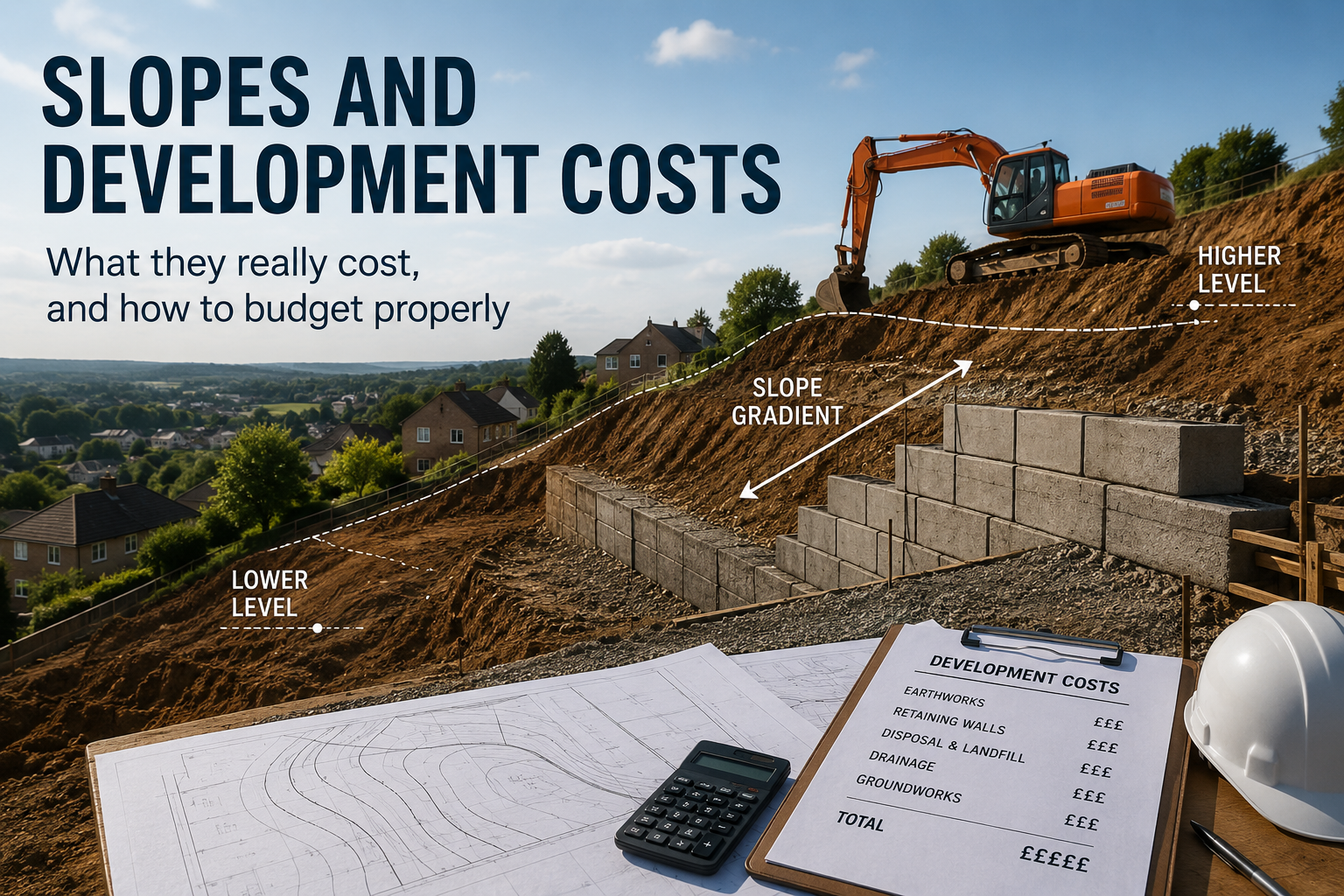
You’ve found what looks like the perfect development site.
The numbers stack up. The location is right. The planning situation looks straightforward.
Then you notice something that makes you pause: there’s a slope.
And that’s when things can get expensive.
A sloping site doesn’t automatically make a development unviable, but it can introduce significant costs that are easy to overlook during the initial appraisal.
The key is knowing what those costs are, how to identify them before you commit, and whether the deal still works once they’re factored in.
Why Slopes Can Cost Developers So Much
Most new developers naturally focus on the building itself: the structure, the number of units, the build cost and the potential revenue.
But before you can build anything, you have to prepare the land.
That’s where slopes can cause problems.
On sloped sites, site preparation and groundworks can account for 15–25% of total development costs, compared with around 5–10% on flat land.
That difference can have a major impact on your profit margin.
Imagine finding a site with what appears to be a modest slope. Nothing dramatic.
Six months later, during the design phase, your architect and surveyor discover that you need a retaining wall running 40 metres along the site boundary.
Suddenly, you’re looking at another £25,000–£50,000, depending on the height, materials and ground conditions.
If that wasn’t included in your original appraisal, it can completely change the deal.
The important point is this:
The slope itself isn’t the cost. The cost comes from what you have to do to make the slope buildable.
You may need to excavate earth, retain it, move it elsewhere or dispose of it. Every intervention adds cost.
Start With a Topographical Survey
Before making an offer on a sloped site, get a topographical survey.
If the seller doesn’t already have one, commission one yourself.
A basic survey may cost around £800–£1,500 and take one or two weeks, but it gives you critical information about:
Contour lines
Vertical drop
Site levels
Gradient
Potential excavation requirements
Without this information, you’re effectively making your development decision blind.
The Three Hidden Costs of Sloping Sites
There are three major cost categories to consider:
Earthworks
Retaining structures
Soil disposal and landfill costs
Individually, each can be significant. Combined, they can seriously damage the viability of a project.
1. Earthworks
If your site slopes down, you may need to cut away earth. If it slopes up, you may need to fill areas.
Excavation can cost approximately £3–£8 per cubic metre, depending on the ground type and disposal method.
That sounds manageable until you start dealing with hundreds of cubic metres.
Suppose you need to move 500 cubic metres of earth.
At £5 per cubic metre, standard excavation appears to cost just £2,500.
But what happens if that soil can’t be reused on site?
It has to be removed and disposed of, potentially introducing landfill and transportation costs. Suddenly, what looked like a relatively small excavation bill can become significantly more expensive.
2. Retaining Walls
Retaining walls hold back earth and stabilise differences in ground level.
On sites with substantial height differences, they may be unavoidable.
Costs vary considerably depending on:
Wall height
Length
Materials
Ground conditions
Structural requirements
For residential developments, retaining walls can range from approximately £300–£800 per linear metre.
At an average of £600 per metre:
40 metres = £24,000
60 metres = £36,000
Those are substantial additions to a development budget.
3. Disposal and Landfill Costs
Excavated soil can become particularly expensive when it cannot be reused on site.
You’re no longer simply paying to dig it out. You also have to transport and dispose of it.
A relatively modest excavation can therefore create a major additional expense once disposal is included.
This is why soil reuse should be considered during the design process rather than after excavation has already begun.
How to Spot an Expensive Slope Before You Buy
Not every sloping site is a problem.
A 1-in-20 gradient across a relatively small site may be perfectly manageable. You may need limited earthworks and no major retaining structures.
A 1-in-5 gradient across a large site is a very different proposition.
Here’s how to assess the difference.
Step 1: Check the Contour Lines
Start with the contour lines on the topographical survey.
If the lines are far apart, the slope is relatively gentle.
If they’re close together, the slope is steeper.
As a general principle:
Closer contour lines = more intervention = potentially higher costs.
Step 2: Calculate the Vertical Drop
Measure the difference in height from one end of the site to the other.
For example, a 2-metre drop across a 30-metre site may require some earthworks but could still be manageable.
A 5-metre drop across the same distance is much more significant and may require extensive excavation and retaining structures.
Calculate the gradient and express it as a ratio, such as:
1-in-20
1-in-15
1-in-10
1-in-5
This gives you a much clearer picture than simply looking at the site and deciding that the slope “doesn’t seem too bad.”
Step 3: Identify Existing and Potential Retaining Walls
Find out whether retaining walls already exist.
Existing walls may need repairing or rebuilding. Alternatively, new retaining structures may be necessary once the site is developed.
Mark potential retaining walls on the site plan and estimate both their length and height.
A 10-metre retaining wall is a very different cost proposition from a 50-metre one.
Step 4: Investigate the Ground Conditions
The type of ground underneath the site matters.
Clay, silt and waterlogged ground can require stronger and more expensive retaining structures than stable, well-drained soil.
If a ground investigation report isn’t already available, consider commissioning one.
A basic ground survey may cost around £1,500–£3,000, but discovering difficult ground conditions before purchasing a site is considerably better than discovering them once construction begins.
Does the Deal Still Work?
Once you understand the slope and its likely costs, you need to answer the most important question:
Is the site still financially viable?
Build a simple model.
Start with your projected development profit and subtract realistic allowances for:
Earthworks
Retaining walls
Soil disposal
Additional drainage
Groundworks
Other slope-related engineering
Then look at what happens to your margin.
If the project remains comfortably profitable, the site may still work.
If the additional costs push your margin below your required threshold — for example, 20% — you may need to reconsider the purchase price or walk away.
A Slope Doesn’t Always Mean “Walk Away”
This is where experienced developers can sometimes find opportunities.
A difficult site can put other buyers off, which may give you greater negotiating power.
You essentially have two levers:
1. Reduce the purchase price.
Account for the additional groundworks and engineering costs when making your offer.
2. Redesign the development.
Instead of forcing a conventional design onto the site, design the building around the existing topography.
Imagine two developers assessing the same sloping site.
Developer A sees the slope, assumes it will be too expensive and walks away.
Developer B investigates it properly, negotiates a lower purchase price and designs the building to work with the slope.
By excavating less and managing the ground strategically, Developer B may actually achieve a stronger return because they bought the site at a discount.
The difference isn’t the slope.
It’s how they approached it.
Three Ways to Reduce the Cost of Developing on a Slope
1. Design With the Slope
Rather than cutting away huge amounts of earth to create a completely level platform, consider designing the building to sit naturally within the topography.
Less excavation can mean lower earthworks, retaining and disposal costs.
2. Reuse Excavated Soil
If you’re cutting earth from one part of the site, consider whether it can be used as fill elsewhere.
Reusing suitable material on site can reduce transportation and disposal costs considerably.
3. Negotiate With the Seller
Use the slope as part of your negotiation.
If significant remedial works are required, the seller may be willing to accept a lower price or potentially contribute towards certain works as part of the sale.
A slope isn’t necessarily a deal-killer.
It can be a negotiation point.
Sloping Site Due-Diligence Checklist
Before committing money or significant time to a sloping site, work through these six questions.
1. Do you have a topographical survey?
If not, commission one.
Indicative cost: £800–£1,500
Indicative time: 1–2 weeks
2. Have you calculated the vertical drop and gradient?
Write the gradient as a ratio.
For example, 1-in-15 means a 1-metre vertical change over 15 metres of horizontal distance.
3. Have you identified potential retaining walls?
Mark them on your site plan and estimate the required length and height.
4. Have you investigated the ground conditions?
Obtain a ground investigation report or speak with a geotechnical engineer about soil type and stability.
5. Have you calculated realistic earthworks and disposal costs?
Don’t rely solely on assumptions.
Speak to local excavation contractors and obtain indicative rates based on the site and expected volume of material.
6. Have you included all slope-related costs in your appraisal?
Subtract them from your projected profit.
If the resulting margin no longer meets your target, reconsider the purchase price, redesign the scheme or walk away.
A Small Upfront Cost Can Prevent a Much Bigger Mistake
Completing the right surveys and assessments before buying a site costs money.
But skipping that due diligence can result in tens of thousands of pounds in unexpected costs later.
The principle is simple:
Spend a little upfront to understand the site before risking a lot more later.
Make this process part of your standard due diligence for every sloping development opportunity.
Final Thoughts
Slopes are solvable problems.
They become expensive problems when you don’t see the costs coming.
Don’t rely on how a site looks from the road or how gentle a slope appears on a plan.
Measure it. Calculate it. Cost it. Then decide.
If the numbers still work, a sloping site could even become an opportunity that other developers have overlooked.
Need Help Assessing a Sloping Site?
Download our Slope Assessment Checklist and use it when reviewing your next development opportunity.
And if you’ve already found or purchased a sloping site and you’re unsure how the additional costs affect its viability, book a free site assessment call. We’ll walk through the site with you, assess the likely costs and help you understand your options.