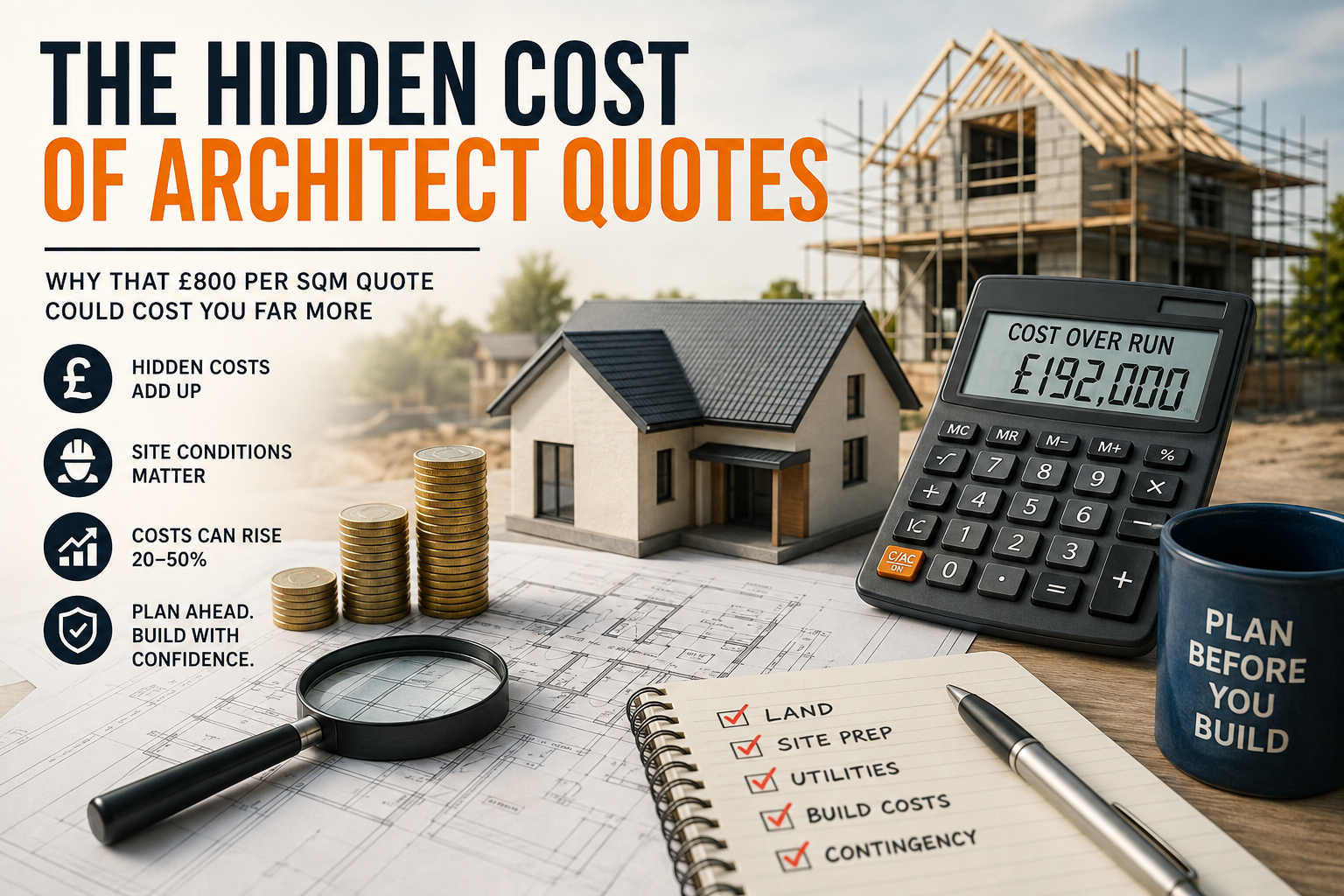
The Hidden Cost of Architect Quotes
When you're planning to build your dream home or take on a property development project, one of the first professionals you may speak to is an architect.
And when they give you an estimated build cost, it's natural to trust it.
But what happens when that estimate is wrong?
Years ago, a couple came to me who were approaching retirement and ready to build their dream home. They had saved for years, secured their land and hired an architect.
Their architect told them they could build the house for £800 per square metre.
They asked whether that figure was realistic. The architect assured them it was.
They trusted the professional.
Unfortunately, that decision eventually contributed to a cost overrun of nearly £200,000 and left them relying on a lifetime mortgage they had never planned to take out.
Their experience highlights an important lesson for anyone planning a build:
An architect's estimate should never be the only figure you use to set your construction budget.
Architects Design — But That Doesn't Make Them Cost Experts
Architects are trained to design buildings. That's their expertise.
But understanding the complete cost of delivering a development is a different skill.
A project's real cost can include far more than the bricks, roof, windows and finishes. You may also need to account for:
Site preparation
Surveys and investigations
Utility connections and upgrades
Demolition
Ground conditions
Contamination
Access restrictions
Labour
Material price changes
Professional fees
Unexpected construction issues
A simple cost-per-square-metre estimate may not account for all of these.
That's where projects can start getting into trouble.
The Costs That Arrive Before You Lay a Single Brick
In the case of this couple, the problems began before construction had even properly started.
Before laying a single brick, they had already spent around £50,000 on architect fees, surveys and other site-related work.
One particularly expensive problem involved electricity.
Their site was located near a golf course, and the existing electrical supply wasn't sufficient for the development. A new supply had to be brought approximately half a mile across the golf course.
That infrastructure work alone cost tens of thousands of pounds.
Was that included in the original £800-per-square-metre estimate?
No.
And that's exactly why relying on a headline build-cost figure can be dangerous.
What's Actually Included in Your Architect's Estimate?
If an architect gives you an estimated cost per square metre, don't simply accept the number.
Ask questions.
You need to understand exactly what is included — and, just as importantly, what isn't.
Ask:
Has the estimate considered the specific conditions of the site?
Are utility connections or upgrades included?
Have surveys been allowed for?
Is demolition required?
Has site preparation been included?
Are difficult access conditions likely to increase costs?
What assumptions have been made about materials and labour?
What professional fees sit outside the figure?
What contingency has been included?
If you're being given a simple per-square-metre figure without a detailed understanding of the plot, treat it as an early estimate rather than a guaranteed budget.
You should also ask what practical construction experience sits behind the estimate.
Is the figure based on detailed, current cost information — or is it simply a general assumption?
The Invisible Costs That Can Destroy a Budget
There is often a significant gap between buying the land and actually constructing the building.
That's where many of the "invisible" development costs appear.
Depending on the project, site preparation alone can become a major expense.
You may need to pay for ground investigations, utility infrastructure, surveys, demolition, contamination assessments, drainage work and other enabling works before construction begins.
These aren't optional extras.
They're part of delivering the development.
And if they're missing from your original budget, you could discover you're tens of thousands of pounds over budget before the main construction work has even begun.
Start With the Site, Not the Design
This is why I recommend understanding your site properly before committing to a design.
Get the appropriate professionals involved early, including a quantity surveyor where appropriate.
Understand what the plot actually requires.
Identify the likely costs of preparing the site.
Then establish a realistic total budget.
Only after you've done that should the design be developed around what you can genuinely afford.
Your architect should be designing within your budget rather than creating the design first and hoping the numbers work afterwards.
From £800 to £1,600 Per Square Metre
Unfortunately, the couple's problems didn't end with the site preparation.
Their architect had originally indicated a build cost of approximately £800 per square metre.
As construction progressed, the cost increased.
By the end of the project, they were paying around:
£1,600 per square metre.
That's double the original figure.
For someone with substantial financial reserves, a major overrun is painful.
For a couple at retirement age relying on a fixed income, it can be devastating.
They had already explained that they couldn't afford to go significantly over budget.
But halfway through construction, they found themselves facing a terrible situation:
The house wasn't finished, and their money was running out.
Stopping wasn't an attractive option because they would be left with an unfinished property.
Finding additional finance was also difficult because of their age and circumstances.
Eventually, they turned to a lifetime mortgage to release additional funds from the property and complete the project.
What was supposed to be their dream retirement home had become a serious long-term financial burden.
Contingency Isn't Optional
Every development carries risk.
Ground conditions can surprise you. Material prices can change. Labour costs can increase. Utility problems can appear. Designs can change. Unexpected work can become necessary.
That's why your budget needs a contingency.
For many projects, it may be sensible to consider a contingency in the region of 20–30%, depending on the project's circumstances and risk profile.
The exact percentage should be determined using appropriate professional advice rather than treated as a universal rule.
The principle, however, is simple:
It's better to finish your project with contingency money remaining than to run out of cash halfway through construction.
Before committing to a project, ask yourself:
If my current estimate turns out to be wrong, do I have enough financial capacity to deal with the difference?
If the answer is no, you need to reconsider the numbers before starting.
Start With Your Numbers — Not Your Architect's
A safer approach begins with determining what you can genuinely afford to spend on the entire project.
That doesn't just mean the construction contract.
Your total development budget should consider areas such as:
Land acquisition
Professional fees
Surveys and investigations
Planning-related costs
Site preparation
Demolition, where required
Utilities and infrastructure
Construction
Finance costs
Contingency
Other project-specific expenses
Once you understand your total available budget, you can work backwards.
That's your real financial boundary.
The design then needs to fit inside it.
Why a Quantity Surveyor Can Be Worth the Investment
Before relying on an architect's estimate, consider obtaining professional cost advice from a quantity surveyor (QS).
A quantity surveyor specialises in construction costs.
They can help you understand what your proposed project is realistically likely to cost and identify expenses that may otherwise be overlooked.
Spending money on accurate cost planning at the beginning can potentially save you from much larger surprises later.
You can also obtain multiple independent estimates.
Rather than relying on a single figure, consider getting three independent cost estimates from builders and/or quantity surveyors.
Compare them.
If there's a substantial difference between the estimates, investigate why.
That process may take additional time, but it's far better to discover a £50,000 problem on a spreadsheet than halfway through construction.
Plan Before You Spend
When I value a development site, I work through detailed cost breakdowns.
I want to understand the build costs.
I want to understand the site costs.
I want to understand the contingency.
And I want to understand the risks before significant money is committed.
That's the level of detail you should aim for when assessing your own project.
Don't build your financial plan around a rough headline figure.
Build it around the realities of your specific site and project.
The couple in this story later told me that they wished they'd understood this process before they began.
Had they investigated the site costs properly, obtained detailed cost advice and established a realistic budget before progressing with the design, their experience could have been very different.
A Cost Overrun Can Become a Life Problem
This story isn't simply about construction costs.
It's about what happens when those costs affect the rest of your life.
A significant cost overrun at retirement age doesn't just change a spreadsheet.
It can affect your financial security, your freedom and what you're able to leave behind.
That's why education and professional advice should be considered an investment rather than an unnecessary expense.
You can spend money upfront understanding the project properly, or potentially spend considerably more correcting expensive mistakes later.
For most people, the first option is far cheaper.
Get the Numbers Right Before You Build
Before you hire an architect or break ground, make sure you understand the complete financial picture.
I've created a Development Cost Breakdown Template to help you work through the major cost categories involved in a project — including land, site preparation, construction and contingency.
It's based on the same principle I use when assessing development opportunities:
Understand the numbers before committing the money.
The difference between a successful development and a financial disaster can come down to planning.
Know your budget.
Understand your site.
Get independent cost advice.
Allow for the unexpected.
And make sure the home or development you're designing is one you can actually afford to finish.
Get the numbers right before you start, and you'll give yourself a much stronger foundation for a successful project.