
Why Cheap Plots Are Often a Trap
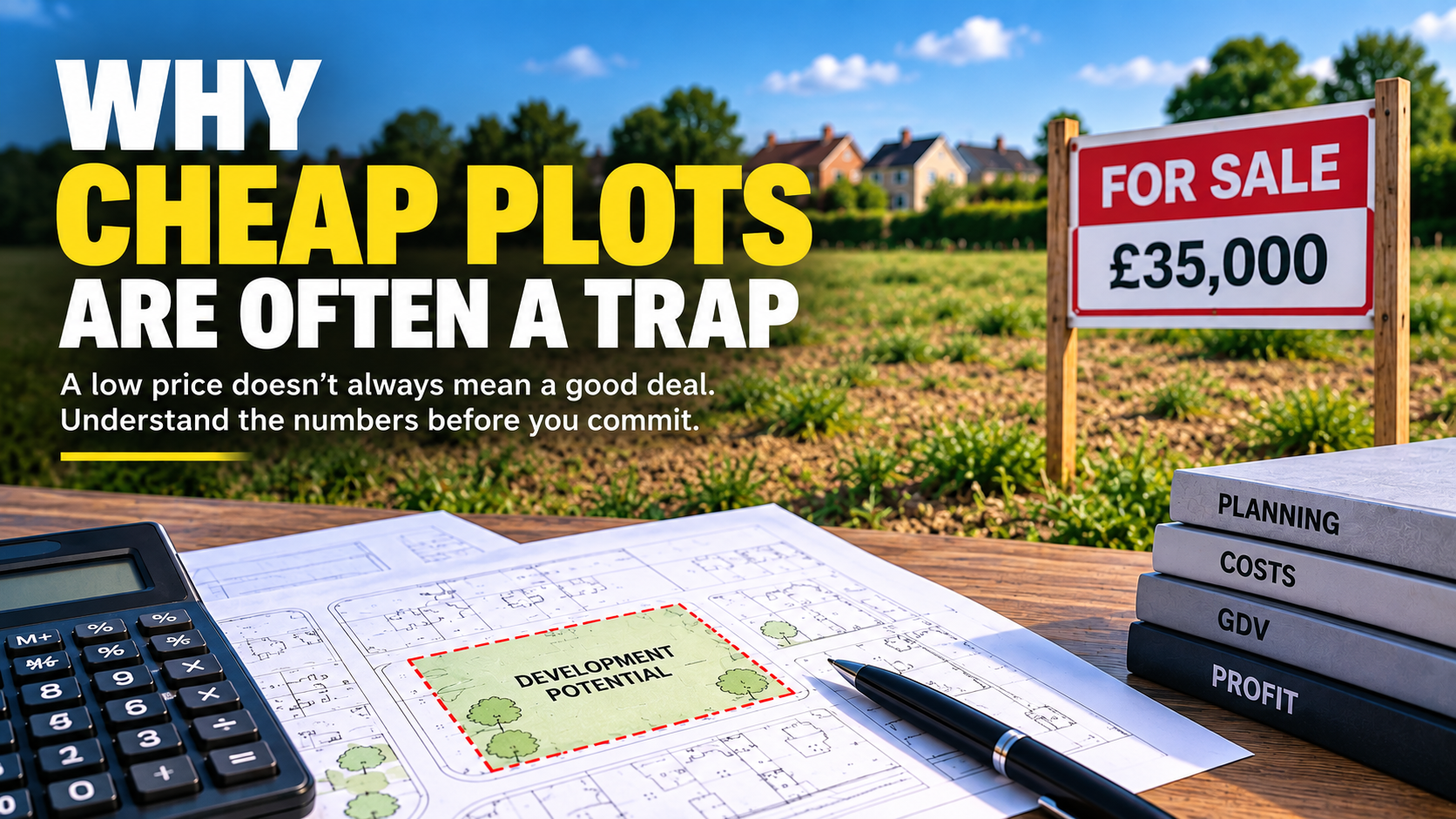
You find a plot of land listed for £35,000 and immediately think you’ve found a steal.
But here’s what many new property developers miss:
A cheap price doesn’t necessarily mean it’s a good deal.
In fact, the cheapest plots are often cheap for a very specific reason. If you don’t understand that reason before committing, you could lose money before you even break ground.
Cheap Land Is Usually Cheap for a Reason
When you see a cheap plot sitting on the open market, ask yourself one important question:
Why have experienced developers already walked away from it?
The best property development opportunities are not always the cheapest ones.
If a plot were obviously capable of producing a strong development profit, there would usually be interest from developers who know how to analyse land.
Experienced developers don't simply look at the asking price. They look at something far more important:
The Gross Development Value (GDV).
If the GDV doesn't support the project, they walk away — ideally before spending significant time or money on the opportunity.
Start With the Gross Development Value
Before getting excited about a cheap plot, research what completed homes are actually selling for in that area.
This gives you the foundation for calculating the project's Gross Development Value.
The key principle is simple:
The price of the land does not determine your profit. The value of the finished development does.
Many new developers analyse deals backwards.
They start by asking:
"How cheap can I buy the land?"
A better starting point is:
"What can I realistically sell the completed development for?"
Once you know that, you can work backwards to establish what the land is actually worth to you.
You Can't Build Your Way Out of a Bad Location
If the GDV in an area is too low, clever construction or aggressive cost-cutting may not be enough to rescue the deal.
Location has a major influence on the value of the finished homes.
If buyers in an area are typically paying around £250,000 for comparable new homes, buying cheap land doesn't automatically mean you can build homes worth £400,000.
The local market ultimately determines what buyers are prepared to pay.
That's why understanding local selling prices should come before committing to the land.
How to Calculate Whether a Plot Works
A basic development appraisal can start with five steps:
Step 1: Research local selling prices
Look at comparable completed homes and establish a realistic selling price, including the average price per square foot where appropriate.
Step 2: Establish what you can realistically build
Estimate the number of units and total saleable floor area the site could support, taking planning constraints into account.
Step 3: Calculate your Gross Development Value
Multiply your realistic selling values by the number and size of homes you expect to create.
Step 4: Deduct all development costs
These may include:
Land acquisition
Construction costs
Professional fees
Planning costs
Finance and interest
Contingency
Abnormal site costs
Other project-specific expenses
Step 5: Assess the potential profit
Once everything has been deducted, ask whether the remaining margin justifies the time, capital and risk involved.
If it doesn't, the fact that the land is cheap is largely irrelevant.
A £35,000 Plot Can Still Be Expensive
Imagine a developer finds a cheap plot in an area where completed homes sell for approximately £200,000 each.
They believe they can build three homes.
That gives them a potential GDV of:
3 × £200,000 = £600,000
Now imagine their total project costs — including land, construction, professional fees, finance and contingency — reach £580,000.
That leaves just:
£20,000 potential profit.
And perhaps the project will take 18 months to complete.
The developer is tying up capital, managing construction and taking significant development risk for a relatively small potential return.
The land looked cheap.
The numbers told a different story.
Don't Overestimate What You Can Build
Another common mistake is assuming a site can accommodate more homes than the planning authority is likely to approve.
A developer might find a cheap plot and calculate the deal based on building five units.
The numbers look fantastic.
But what happens if the planning authority will realistically approve only three?
The entire appraisal changes.
If the developer has already committed to buying the site based on five units, they may suddenly be left with a project that doesn't work financially.
Before making an offer, research what has actually been approved locally.
Look at nearby planning applications, understand the character and density of surrounding developments and, where appropriate, speak to planning professionals or the local planning authority.
Don't base your development appraisal on an assumption.
Don't Forget Abnormal Costs
Cheap plots can also hide expensive problems.
Site-specific issues can dramatically increase development costs and turn what appeared to be a bargain into a financial headache.
Depending on the site, these could include unusual foundation requirements, drainage problems, utility connections, contamination, difficult access, demolition, retaining structures or other abnormal works.
This is why land should never be assessed on purchase price alone.
The question isn't:
"How cheap is the land?"
It's:
"What will the entire development cost, and what will it ultimately be worth?"
Work Backwards From the Finished Development
The right way to evaluate land is to start with the output and work backwards.
Your framework should look something like this:
Selling Price → Development Potential → GDV → Total Costs → Required Profit → Land Value
Not:
Cheap Land → Buy It → Hope the Numbers Work
This change in thinking can prevent you from committing capital to projects that should never have progressed beyond the initial appraisal.
Cheap Land vs Profitable Land
Consider two hypothetical plots.
One costs £50,000 but produces virtually no development profit.
Another costs £200,000 but supports £100,000 in potential profit after the project's costs have been properly assessed.
Which land price looks cheaper is obvious.
But that's not the important question.
The important question is:
Which development actually works?
That's the distinction property developers need to make.
A Real Example of Proper Land Appraisal
In one example, a landowner believed their site was worth somewhere between £250,000 and £300,000.
But after carrying out a proper appraisal and working backwards from the site's development potential and GDV, the developer concluded that its value was much closer to £90,000.
The land was eventually secured for around £100,000.
It wasn't simply finding a "cheap plot" that made the opportunity work.
It was understanding what the land was genuinely worth as a development opportunity.
That disciplined approach ultimately contributed to a multi-million-pound development pipeline.
Why the Best Opportunities May Be Off-Market
There's another point worth remembering.
Land advertised on the open market has usually been seen by many people.
If an apparently attractive development plot has been sitting there for a long time at a low price, it's worth investigating why.
That doesn't automatically mean there's something wrong with it. But it does mean you should analyse it carefully rather than assuming the asking price represents an opportunity.
Some of the strongest development opportunities can be found before they reach the open market.
Developers can source opportunities through:
Direct approaches to landowners
Local relationships and networks
Map-based research
Planning research
Professional contacts
Targeted off-market sourcing
Instead of waiting for cheap plots to appear on Rightmove or Zoopla, building a consistent land-sourcing system can help you identify opportunities before they're widely advertised.
Stop Chasing Cheap. Start Chasing Viable Deals.
A cheap plot is not automatically a bargain.
And an expensive plot isn't automatically a bad deal.
What matters is whether the numbers work.
Before making an offer, understand:
What can realistically be built?
What will the finished development realistically sell for?
What will the entire project cost?
What profit margin remains after those costs?
Once you understand those numbers, you can establish what the land is actually worth to you.
That's the difference between simply buying cheap land and buying land that supports a viable development.
See the Framework in Action
In our next webinar, I'll show you a real example of how to evaluate a cheap plot and determine whether the numbers actually work.
You'll see the numbers, the appraisal process and the framework used to identify which opportunities are worth pursuing — and which could waste your time and money.
Register for the webinar to see the example in action and learn how to apply the same approach to your own land evaluations.
Because once you understand that a cheap plot isn't necessarily a good plot, the way you evaluate development opportunities changes completely.